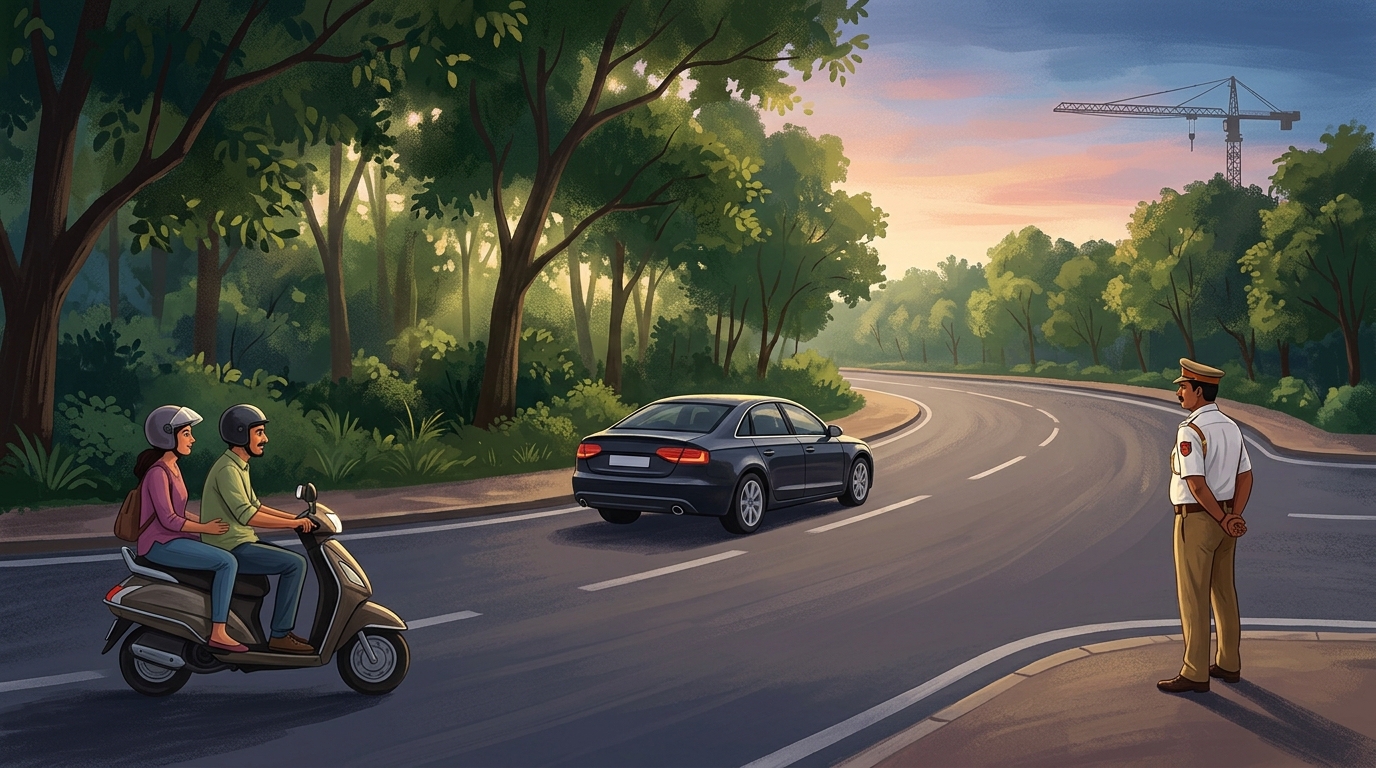
There is a familiar arc to bold civic decisions in Indian cities: resistance, resentment, grudging tolerance, and then — sometimes — genuine appreciation. The one-way traffic loop around KBR Park in Jubilee Hills appears to have completed that full arc. Commuters who once complained bitterly about longer detours are now acknowledging that the change has made their daily drive less stressful, according to reports from Telangana Today.
From Frustration to Acceptance
When the Hyderabad Traffic Police first implemented the one-way system around KBR Park, it was not a popular move. Residents and regular commuters protested the inconvenience of rerouted paths and what felt like an arbitrary imposition on a route they had used for years. The backlash was vocal and immediate.
Yet the traffic police and the state government held their ground. Over time, the data and the lived experience of commuters began to tell a different story. Bottlenecks reduced. Near-miss incidents at contentious junctions became less frequent. The road around one of Hyderabad's most beloved green lungs became calmer, more predictable, and — as commuters are now admitting — more humane.
This is a genuine win for the Hyderabad Traffic Police and for a government that chose the right long-term outcome over short-term popularity. It took courage, and it worked.
The Principle Behind the Policy
What the KBR Park experience underlines is something urban planners and traffic engineers have long argued: well-designed traffic interventions often feel disruptive before they feel beneficial. The human instinct is to resist change to familiar routes, even when those routes are objectively dysfunctional. Public anger in the early days of such a measure is not evidence that the measure is wrong — it is often evidence that it is necessary.
The lesson for city administrators is not to mistake early resistance for final judgment. Hyderabad's traffic authorities deserve credit for staying the course.
The Next Challenge: Proposed Construction and Tree Felling
The harder test, however, lies ahead. Proposed infrastructure construction in the area — potentially involving the felling of a significant number of trees — is already drawing concern. Unlike traffic pattern changes, which are reversible and invisible once accepted, tree removal is permanent and visceral. Green cover lost cannot be easily restored on a human timescale.
The emotional stakes are higher, and the scrutiny will be sharper. Residents who came around on the one-way system may not extend the same patience when the loss is ecological rather than merely logistical.
Yet if the authorities approach this the same way — with a clear rationale, transparent communication, and a genuine commitment to the public good — there is reason to believe that acceptance is possible here too. The condition, as always, is that the will to do the right thing must precede the decision, not follow the controversy.
What This Means for Neopolis Residents
For professionals and residents in Kokapet and Narsingi, this story carries direct relevance. The Neopolis district sits at the edge of Hyderabad's rapidly expanding western corridor, where infrastructure decisions — road design, green cover, traffic management — are being made at speed and at scale.
- Traffic interventions that seem inconvenient today, such as new one-ways, junction redesigns or access restrictions near Financial District feeder roads, may be worth evaluating on a longer horizon before opposing them outright.
- At the same time, any construction that involves tree removal in this district warrants close civic attention. The green buffer along Narsingi and the outer stretches of Kokapet is part of what makes the area liveable — and that is not a small thing to trade away.
- The KBR precedent also suggests that Hyderabad's traffic and civic bodies are capable of implementing bold, evidence-based decisions. Engaging constructively — asking for plans, timelines and mitigation measures — is more productive than reflexive opposition.
Bold governance works best when citizens push it to be accountable, not when they simply push back. The KBR one-way story is proof that the former can produce real results for a city growing as fast as Hyderabad.