This week's most consequential story for Hyderabad's business and professional community emerges not from a product launch or a policy announcement, but from a courtroom ruling that has reignited a long-simmering debate about how India's insolvency framework treats the powerful versus the ordinary debtor.
KTR Questions the NCLT's Reported Waiver to Subhash Chandra
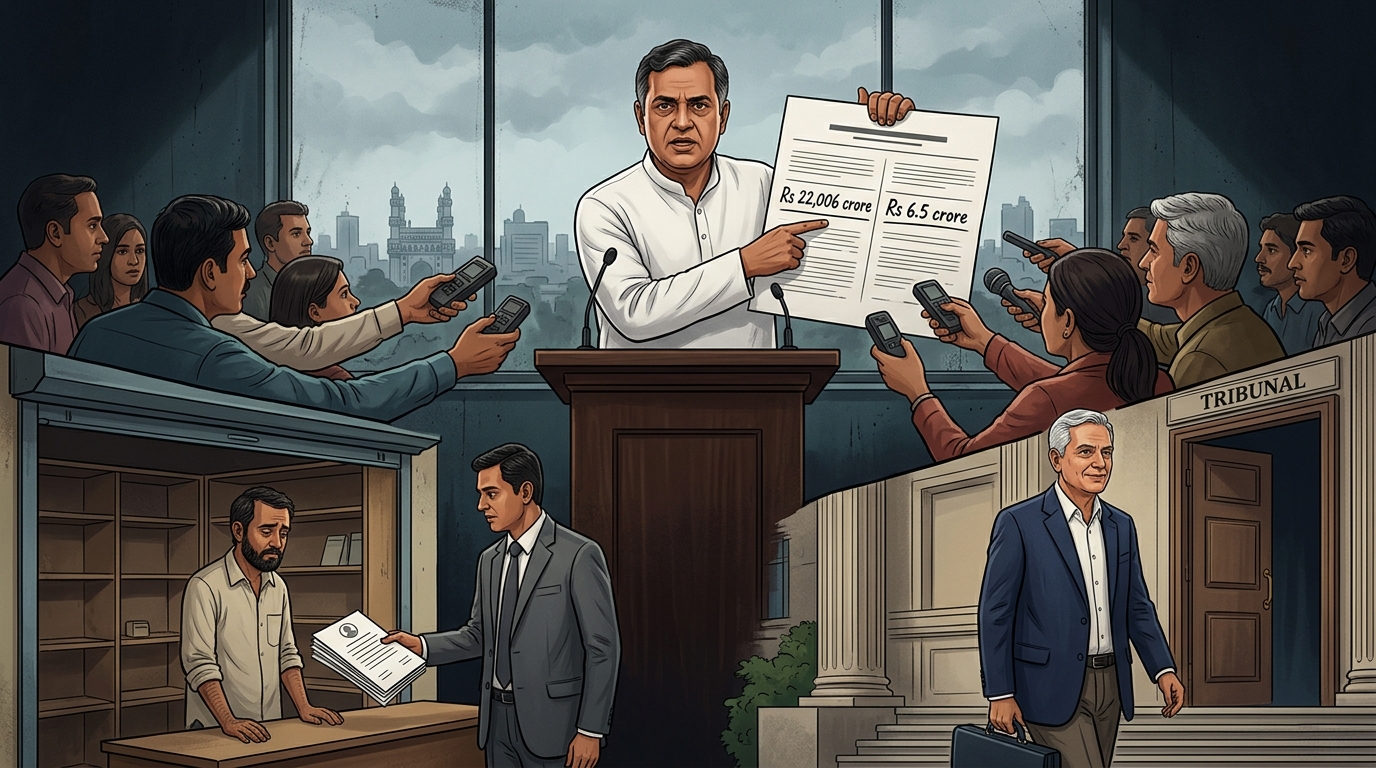
BRS working president K.T. Rama Rao has publicly questioned the reported National Company Law Tribunal (NCLT) approval of a settlement in which media baron Subhash Chandra — founder of the Zee Entertainment group — allegedly paid approximately Rs 6.5 crore to settle dues totalling Rs 22,006 crore. If the figures being cited are accurate, that amounts to a waiver of nearly 99.97 per cent of the outstanding liability.
KTR's intervention is politically motivated, no doubt — the BRS is in opposition and every such episode is an opportunity to embarrass the ruling establishment. But the underlying concern he is raising is one that transcends party lines: does India's insolvency and debt resolution architecture work equitably, or does it systematically favour large promoters with access to legal resources, political networks, and the patience to outlast creditors?
This is not an abstract question for Hyderabad's startup and investment ecosystem. Telangana is home to a growing community of angel investors, venture funds, and institutional lenders who back early-stage companies. The credibility of debt recovery mechanisms directly shapes the cost of capital and the willingness of investors to take risks in this market.
Why This Matters Beyond Politics
Consider the asymmetry at play. A small business owner in Hyderabad who defaults on a working capital loan from a public sector bank faces aggressive recovery action — asset seizure, CIBIL score destruction, and in some cases, criminal proceedings. Meanwhile, large corporate defaulters with sophisticated legal teams can navigate the NCLT process over years and, reportedly, emerge having paid fractions of their dues.
This structural inequity has real consequences for the Telangana economy:
- Investor confidence: Institutional lenders and minority shareholders who watch large promoters escape liability with minimal consequence become more cautious about deploying capital into Indian ventures, raising the effective cost of funding for startups and MSMEs.
- Moral hazard: When high-profile settlements appear to reward delay and legal maneuvering over honest repayment, it sends a signal that scale and influence are more valuable than financial discipline.
- Public sector bank health: Many of the creditors in large insolvency cases are public sector banks — institutions whose health ultimately affects credit availability for the broader economy, including Hyderabad's IT corridor businesses that depend on trade finance and project loans.
A Note on Scope and Caution
It is worth being precise: the NCLT is a national body, and the Subhash Chandra case is not a Telangana-specific matter. However, KTR's public questioning of the ruling — as a Telangana political figure commenting on a case with broad implications for business regulation — brings this issue into the state's political discourse. Hyderabad-based professionals, investors, and entrepreneurs are stakeholders in how India's insolvency framework evolves, and that makes this conversation relevant to this readership.
It is also important to note that the full legal record of the NCLT proceedings has not been independently verified by this publication. The figures cited by KTR — and reported in the press — should be treated as contested claims until the NCLT's official order is examined in detail.
What This Means for You
- If you are an investor or angel: Pay close attention to the evolution of insolvency jurisprudence in India. The NCLT framework is still maturing, and the outcomes of high-profile cases will shape precedent. Engage with industry bodies like TiE Hyderabad and IVCA to advocate for stronger minority creditor and investor protections.
- If you are a founder or MSME owner: Understand that the regulatory environment for debt resolution is uneven. Maintain clean books, build relationships with multiple lenders, and do not assume that the protections available to large corporates will be available to you in a distress scenario.
- If you are an IT or corporate professional: The health of India's financial system — including how it handles bad debt — has downstream effects on the macroeconomic environment your employer operates in. An economy where large defaults go largely unpunished is one where credit is either more expensive or more restricted for everyone else.
- Broadly: Demand transparency. Public accountability for NCLT decisions — including publishing detailed settlement rationales — is a reasonable ask from a professional community that believes in institutional integrity.