Monday's news cycle offered slim pickings for Telangana-specific developments, but the one story that demands attention from Hyderabad's working population is the TGSRTC bus accident near Batasingaram — a collision that injured at least 15 passengers and once again surfaces uncomfortable questions about the state of public transportation infrastructure in the region.
What Happened on NH-65
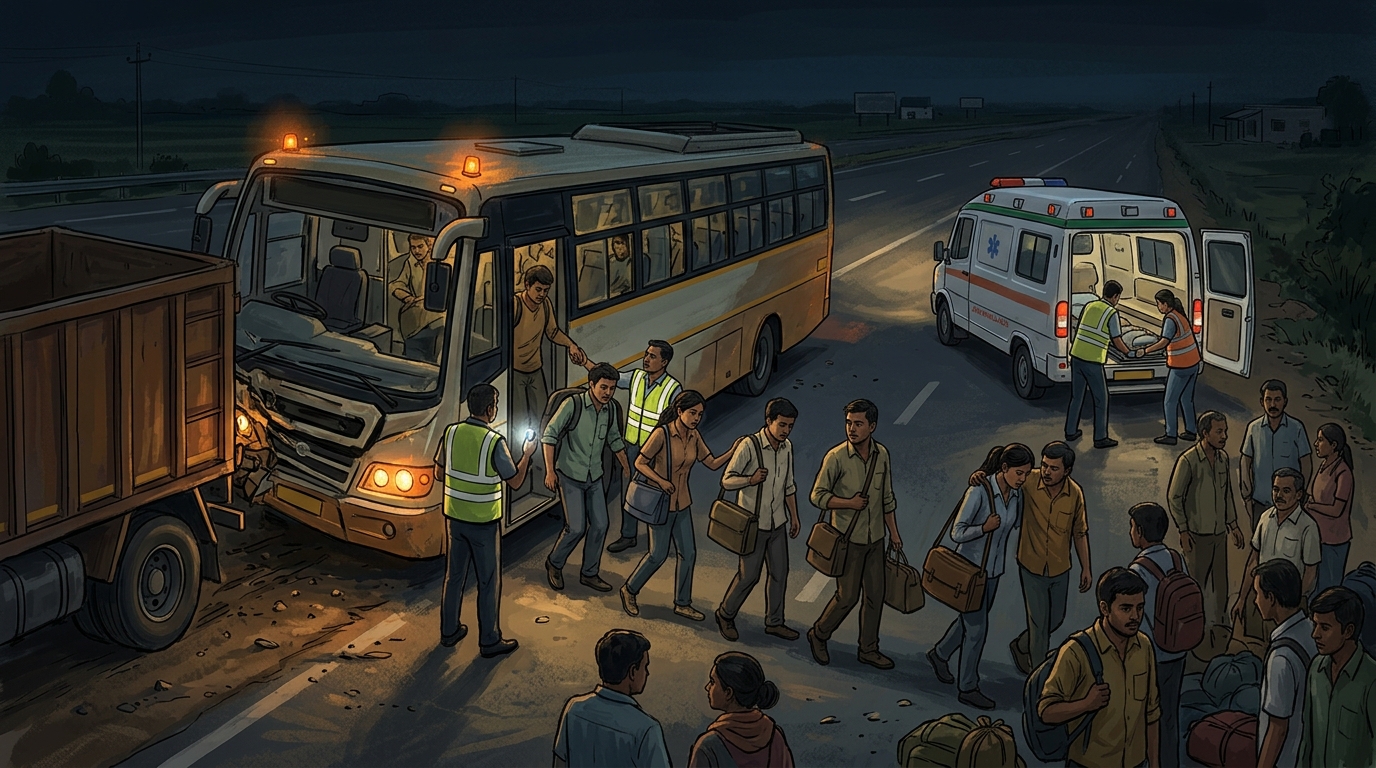
A TGSRTC bus travelling the Khammam–Hyderabad route rammed into a stationary truck at Batasingaram on National Highway 65, injuring at least 15 passengers. The injured were shifted to a government hospital. While the immediate cause is still under investigation, the incident fits a troubling pattern: TGSRTC buses operating on intercity corridors face persistent challenges including ageing fleet vehicles, driver fatigue on long routes, and inadequate highway lighting and signage at key junctions like Batasingaram.
Why This Matters Beyond a Traffic Bulletin
For Hyderabad's IT and business community, this may seem like a peripheral story — most tech workers commute by cab aggregator or personal vehicle. But that assumption deserves scrutiny. A significant and often invisible portion of Hyderabad's technology workforce — particularly junior engineers, BPO employees, and support staff working odd-hour shifts — relies on TGSRTC intercity and city services. These workers are disproportionately from Tier-2 cities and towns like Khammam, Warangal, and Nalgonda, commuting into the metro or using long-distance buses to return home during festival breaks.
The Batasingaram stretch of NH-65 is also a critical artery connecting the city to its southeastern industrial and logistics hubs. Repeated incidents on this corridor affect freight movement, supply chains, and the broader operational fabric of businesses that many Hyderabad professionals depend on indirectly.
The Structural Problem with TGSRTC
TGSRTC has long operated under financial strain — a corporation that carries millions of passengers while struggling with debt, fare revision controversies, and deferred fleet modernisation. Worker unions have repeatedly flagged driver fatigue resulting from understaffing and extended shift schedules. These are not abstract grievances; they translate directly into road safety outcomes. A well-funded, well-staffed public transporter is not a charity — it is critical infrastructure. The state government's reluctance to invest meaningfully in TGSRTC's operational health, while simultaneously promoting Hyderabad as a world-class tech destination, represents a policy contradiction that deserves sharper public scrutiny.
It is also worth noting that the injured passengers were shifted to a government hospital — a reminder that public healthcare and public transport form an interconnected safety net that serves working people when private alternatives fail them. Both systems require sustained, equitable investment, not just headline-grabbing announcements.
The Broader Context: What Other Headlines Tell Us
The remaining headlines from today's news cycle — Tamil Nadu weather alerts, South Korean auto export figures, national equity market movements, and Mumbai celebrity news — fall outside Telangana's scope and are not relevant to this digest. Their prominence in a Telangana-branded publication, however, is itself a small editorial observation: on quieter news days, the absence of robust state-level accountability journalism becomes more visible.
What This Means for You
- If you manage a team: Consider whether your organisation's transport reimbursement and shift-timing policies adequately account for employees who rely on public or shared transport — particularly those commuting from outside the metro.
- If you're an entrepreneur or startup founder: Logistics and last-mile infrastructure on corridors like NH-65 directly affect vendor reliability and supply chain timelines. TGSRTC's operational health is your operational health.
- If you're a policy-aware professional: Engage with TGSRTC reform as a legitimate civic issue. Advocate for fleet modernisation, fair driver working conditions, and transparent safety audits — the same standards you'd expect from any service provider in your industry.
- If you use intercity buses: Report unsafe conditions to TGSRTC's grievance portal and local transport authorities. Collective feedback from educated, vocal commuters can shift institutional priorities.
Public transport safety is not a niche concern. It is the connective tissue of an equitable, functional city — and Hyderabad's ambitions as a global tech hub ring hollow if the people who build that hub cannot travel safely.