This week's international news cycle is a reminder that the world's crises rarely stay neatly contained within their borders. For Hyderabad's IT professionals, startup founders, and business community, three developments — Nepal's catastrophic flooding, the BBC's documented account of Israeli settler violence in the West Bank, and Norway's royal transition — each carry implications worth paying attention to, even if they feel geographically distant.
Nepal's Floods: A Human and Regional Catastrophe
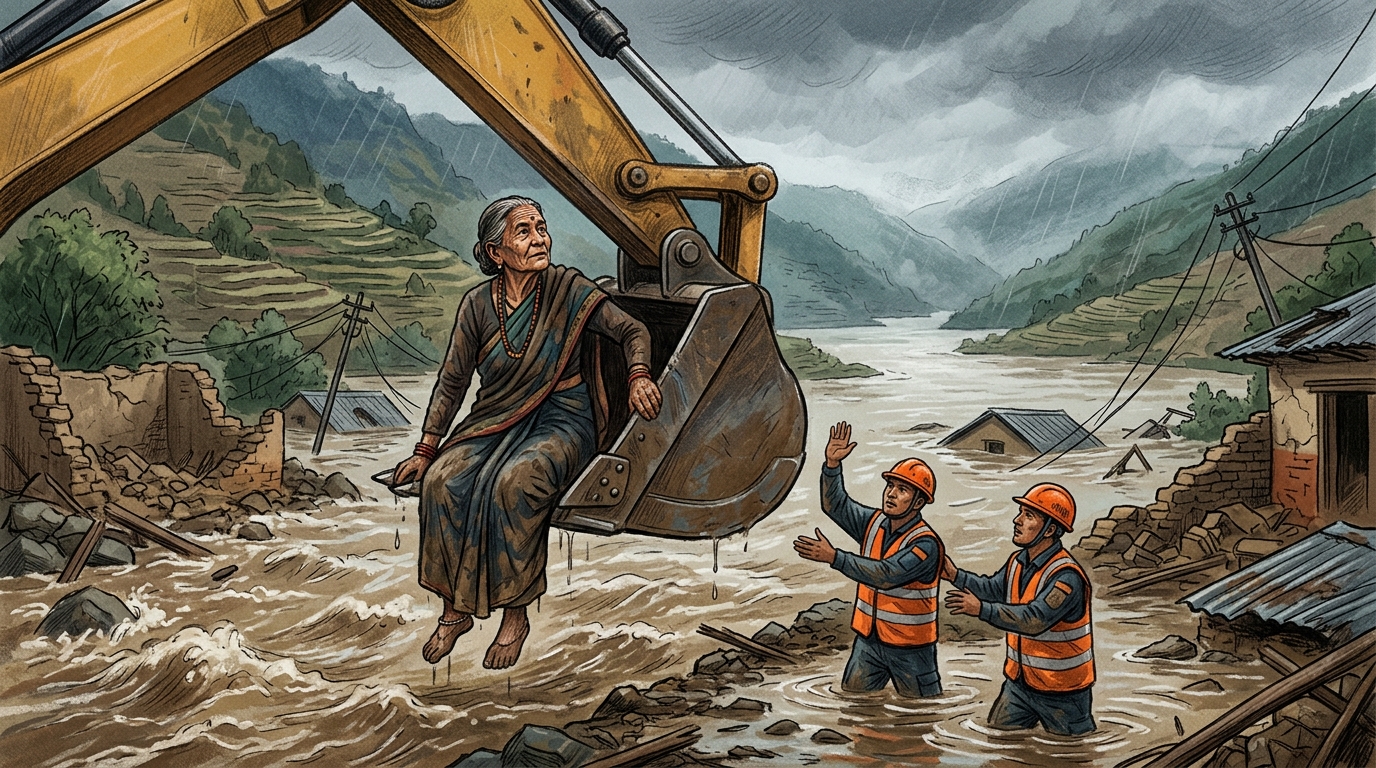
The flash floods that swept through Nepal this week have left a trail of devastation that is both heartbreaking and alarming. Among the images that emerged was that of 97-year-old Guna Maya Bohara, rescued by excavator, described by those who found her as looking like 'a warrior.' Separately, at least 33 British nationals — including a 13-year-old girl and a 14-year-old boy — remain missing, underscoring how the disaster has struck both local communities and international visitors with equal indiscrimination.
Nepal occupies a fragile position in South Asia's ecological and economic architecture. As climate scientists have repeatedly warned, the Himalayan region is experiencing accelerated glacial melt and increasingly erratic monsoon patterns — a direct consequence of global warming driven substantially by industrial emissions from the world's largest economies. These floods are not isolated weather events; they are symptoms of a deeper systemic failure in global climate governance.
For Hyderabad's tech and business community, Nepal's crisis is a signal worth reading carefully. Disaster-driven displacement, infrastructure collapse, and humanitarian emergencies in the broader South Asian neighbourhood tend to ripple outward — affecting regional supply chains, cross-border talent mobility, and the humanitarian budgets that donor nations redirect, sometimes at the cost of development partnerships.
Settler Violence in the West Bank: Geopolitical Friction With Economic Edges
The BBC's week-long tracking of Israeli settler attacks on Palestinians in the occupied West Bank paints a disturbing picture of systematic violence operating with near-impunity. Lucy Williamson's ground reporting documents a pattern that human rights organisations have flagged for years — but which is now receiving renewed mainstream attention amid the broader Gaza conflict.
Why does this matter to professionals in Hyderabad? The Middle East remains one of the largest destination markets for Indian IT services, enterprise software, and contract labour. Israel's tech sector, in particular, has deep ties with Indian IT majors. Prolonged instability in the West Bank and the broader region raises the cost of doing business, creates uncertainty for firms with regional exposure, and — critically — raises ethical questions for companies navigating ESG (Environmental, Social, and Governance) frameworks that increasingly scrutinise geopolitical risk and human rights compliance in their supply chains and partnerships.
Progressive investors and institutional funds in Europe and North America are already applying pressure on firms with Israel-linked contracts. For Indian IT companies with dual exposure — to Israeli tech clients and to Western ESG-conscious institutional investors — this is a tension that will only intensify.
Norway's Royal Transition: Symbolic Stability in an Uncertain Europe
King Harald of Norway passed away on Friday, with Crown Prince Haakon ascending to the throne. Norwegians mourned a monarch widely described as the nation's 'grandfather' — a figure of quiet, inclusive leadership over three decades. While a royal succession may seem ceremonially distant from Hyderabad's boardrooms, Norway is not a peripheral player in global economic affairs. It manages one of the world's largest sovereign wealth funds, the Government Pension Fund Global, which holds stakes in thousands of companies worldwide, including many in the technology sector.
Leadership transitions in Norway — even symbolic ones — can subtly influence the policy temperament around that fund's investment philosophy, its stance on ethical exclusions, and its engagement with global climate and labour standards. These are signals that long-term institutional investors and fund managers watch.
The Climate Thread Running Through All of It
What connects Nepal's floods, the West Bank's instability, and even Norway's moment of national reflection is a common undercurrent: the world is navigating multiple overlapping crises — ecological, geopolitical, and institutional — simultaneously. For professionals in Hyderabad's knowledge economy, these are not background noise. They shape client markets, investment flows, talent ecosystems, and the ethical expectations placed on global businesses.
What This Means for You
- IT & Services Professionals: Monitor client exposure to Middle East markets, particularly firms with Israel-linked contracts, as ESG scrutiny intensifies globally. Geopolitical instability in the region can affect project continuity and client sentiment.
- Startup Founders & Investors: Climate-linked disasters like Nepal's floods are accelerating interest in climate-tech, disaster-response platforms, and resilient infrastructure — sectors worth watching for both impact and opportunity.
- Corporate Employees & HR Leaders: Regional humanitarian crises affect talent pipelines and mobility. Companies with South Asian recruitment networks should have contingency frameworks for climate-driven displacement events.
- ESG-Aware Professionals: Norway's sovereign wealth fund remains a bellwether for responsible investment norms globally. Its policy direction under new leadership is worth tracking for anyone working on impact investing or sustainability reporting.