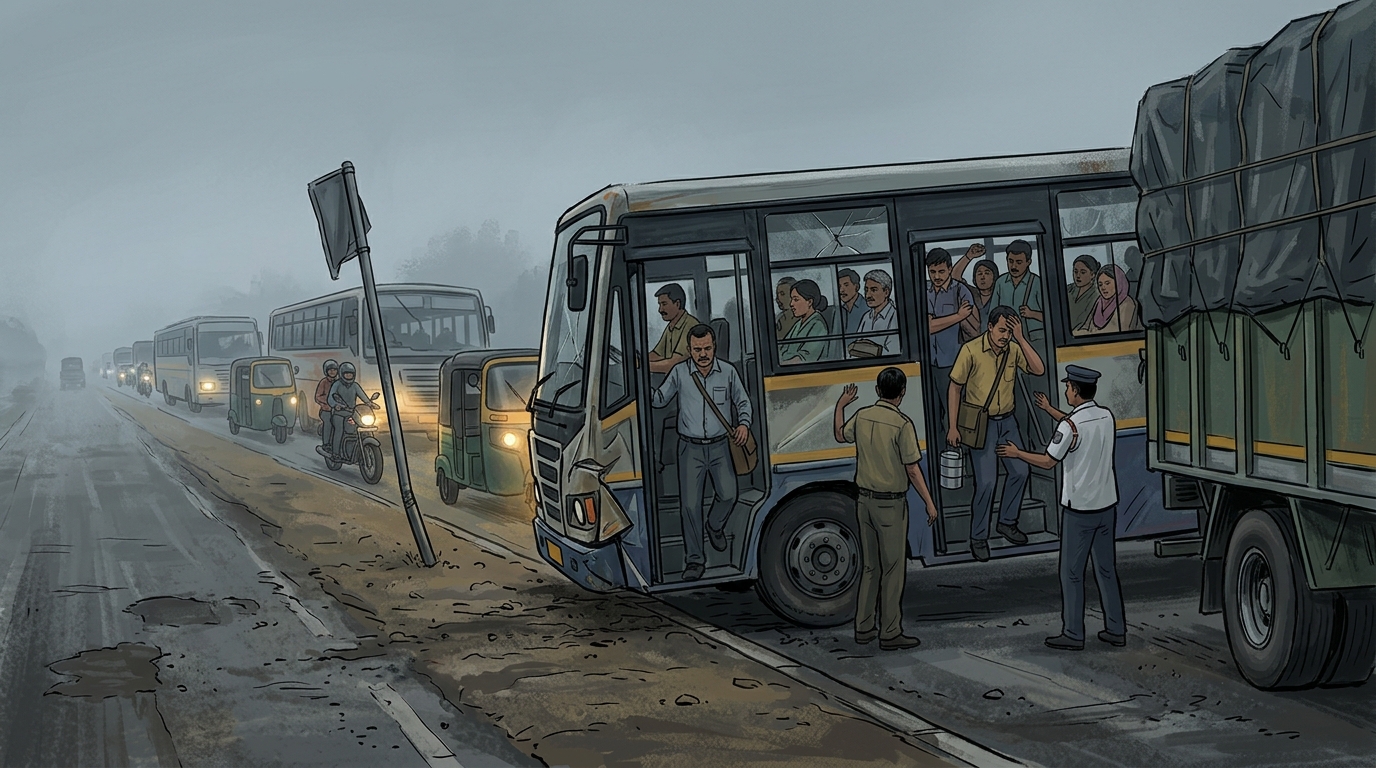
For the thousands of IT professionals, gig workers, and corporate employees who rely on TSRTC buses and road networks to navigate Hyderabad's sprawling tech corridors every day, this week delivered a sobering reminder of how vulnerable public infrastructure remains — and how the cost of neglect is measured not in budget lines, but in human lives.
Hayathnagar Road Accident: 20 Injured in Lorry-Bus Collision
A serious road accident on Hayathnagar Road left 20 people injured after a lorry collided with an RTC bus. The injured were shifted to a nearby hospital for treatment. While the immediate cause of the collision is still being investigated, the incident is not an isolated event — it sits within a troubling pattern of heavy vehicle-public transport conflicts on Hyderabad's arterial roads.
Hayathnagar, situated on the southeastern edge of the city, serves as a commuter corridor for a significant number of workers travelling toward the city's industrial and logistics zones. The stretch carries a dense mix of freight lorries, TSRTC buses, and private vehicles, yet road safety infrastructure — including signage, speed enforcement mechanisms, and dedicated freight lanes — remains chronically underfunded.
For professionals who dismiss public bus travel as someone else's concern, it is worth noting that road accidents on feeder routes directly affect traffic load redistribution onto Outer Ring Road and inner-city tech corridors including Uppal, LB Nagar, and ultimately Hitec City and Gachibowli. A disrupted arterial route doesn't stay local for long.
The Systemic Problem Behind the Statistics
Hyderabad's rapid commercial and residential expansion — particularly eastward and southeastward — has not been matched by proportionate investment in road safety audits, freight movement regulation, or bus fleet modernisation. TSRTC buses, many of which are ageing, continue to operate on high-density corridors without adequate lane separation from heavy commercial vehicles.
From a worker-welfare standpoint, this matters acutely. A significant portion of Hyderabad's workforce — including lower-wage IT support staff, contract workers at tech campuses, and factory employees — depend on TSRTC services precisely because they cannot afford private cab aggregators or personal vehicles. When a bus becomes a site of injury rather than safe transit, it is overwhelmingly these workers who bear the risk.
Civil society groups and urban mobility advocates have repeatedly called on the GHMC and the Hyderabad Metropolitan Development Authority (HMDA) to conduct systematic road safety audits on high-freight corridors and mandate GPS-based speed monitoring for heavy vehicles. Progress on these fronts has been slow.
A Note on Scope: What Didn't Make This Digest
Several headlines in today's news cycle — including national commentary on AI safety risks, a reality television controversy, and state-level ceremonial events — fall outside Hyderabad's immediate civic and professional domain. While AI ethics is a conversation deeply relevant to Hyderabad's tech sector, a researcher's individual statement on X does not constitute local policy or workplace news. We flag it as a topic worth watching but not one requiring immediate professional action at the city level today.
What This Means for You
- If you commute by TSRTC or use arterial roads: The Hayathnagar corridor warrants caution. Allow additional travel time and stay updated on TSRTC advisories following the accident.
- If you manage a team or run a startup: Consider whether your workplace transport policies adequately account for the risks faced by contractual or lower-wage staff who rely on public buses — and whether your company has advocated for safer public infrastructure in GHMC forums.
- If you engage with civic policy: This is a moment to press GHMC and HMDA representatives for a published timeline on road safety audits for freight-heavy corridors in the city's growth zones. Public accountability on infrastructure cannot wait for the next fatality.
- Broadly: Road safety in Hyderabad is not a peripheral issue — it is a labour welfare issue, a productivity issue, and an equity issue. The workers most at risk are those with the least power to demand safer conditions.