Drive through Kokapet on any given morning and the skyline tells a story of extraordinary ambition. Tower cranes dot the horizon. Hoardings promise luxury residences with panoramic views of the financial district. Sales offices gleam with architectural renders of buildings that have not yet broken ground. It is a landscape of confidence — or, depending on how you read the signals, a landscape of overextension.
The China Warning
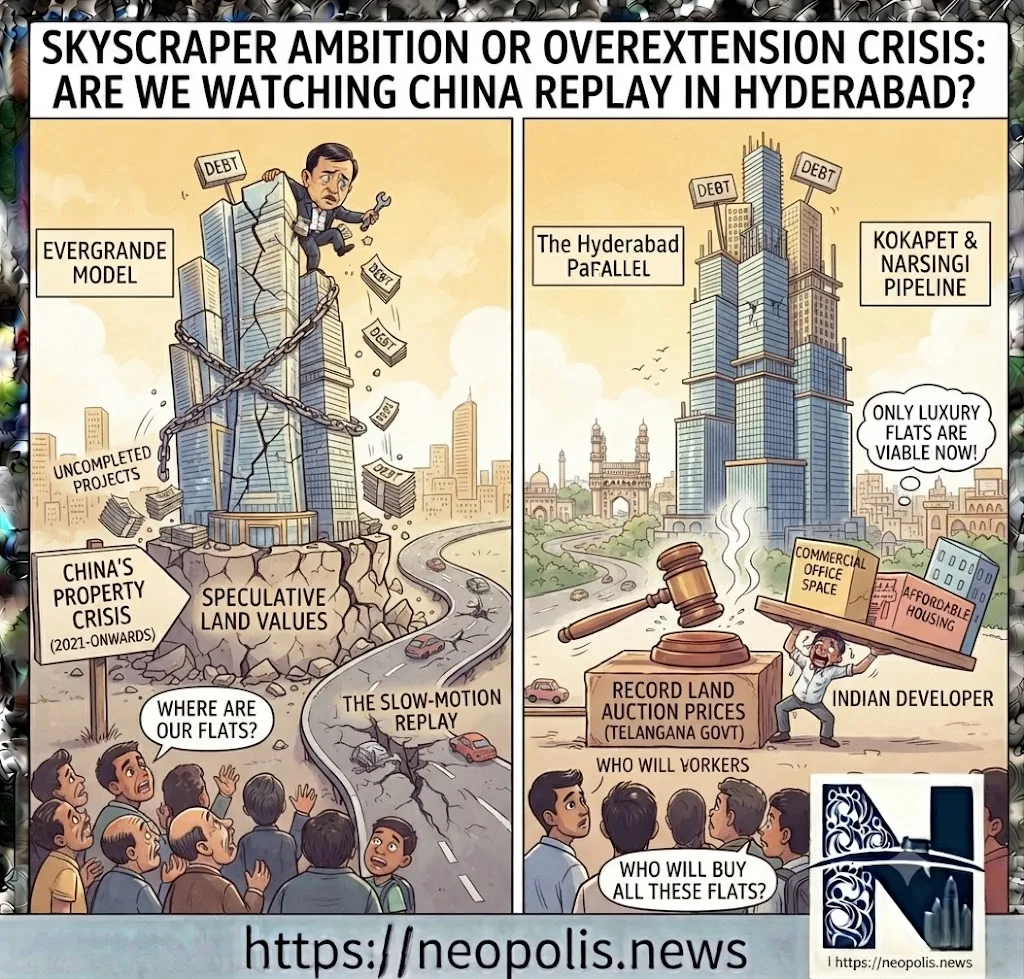
The arrest and jailing of Hui Ka Yan, the founder of China Evergrande — once the world's most valuable property developer — serves as one of the starkest cautionary tales in modern economic history. Evergrande's collapse, the product of years of debt-fuelled expansion, uncompleted projects and a government that kept enabling land auctions at ever-rising prices, did not happen overnight. It was the cumulative result of a system where land became a speculative asset rather than a productive one, where developers borrowed against tomorrow's sales to fund today's construction, and where local governments grew dependent on land revenues to balance their own books.
The parallels to what is unfolding in parts of urban India — and in Hyderabad in particular — are not perfect, but they are uncomfortable enough to warrant serious attention.
The Hyderabad Land Auction Spiral
The Telangana government has in recent years auctioned land parcels in the Hyderabad Financial District corridor — which directly abuts Kokapet and Narsingi — at prices that have set repeated records. These are not small numbers. The per-acre valuations reached at some of these auctions are among the highest in the country outside Mumbai.
At those price points, the arithmetic becomes brutally narrow. Developers who acquire land at such costs have very few viable paths to profitability. Commercial office space, which once anchored mixed-use developments in this corridor, cannot reliably generate the returns needed to justify those land costs — particularly as the global technology sector moderates its expansion and the demand for new office inventory softens. Affordable or mid-segment housing is similarly unviable. What remains is the residential skyscraper: high-floor, high-price, premium-positioned apartments aimed at a buyer who can afford to pay in crores.
And so, almost by design, every new land parcel in Kokapet and Narsingi is destined to become a tower of luxury flats. The government's pricing of land has effectively made it so.
But Where Are the Buyers?
This is where the story becomes complicated. National data and reporting from major outlets point to a cooling in housing demand, particularly in the sub-one-crore segment. Tech-sector layoffs and broader job uncertainty among India's IT workforce — the very demographic that has historically driven residential demand in Hyderabad's western corridor — are beginning to affect purchasing decisions. Buyers who might have stretched for a home loan two years ago are now pausing, reassessing, waiting.
The premium segment, which Kokapet's pipeline disproportionately targets, has shown more resilience. But resilience is not the same as abundance. If dozens of projects — each running to hundreds of units priced at two crore and above — complete and seek buyers within the same three-to-five-year window, the absorption question becomes acute. Who, exactly, is buying all of these flats?
The Pattern Worth Watching
China's property crisis did not announce itself. For years, tier-one Chinese cities looked like proof that the model worked. Prices rose, developers expanded, governments collected land revenues, and buyers — fearful of being priced out — kept purchasing. The system appeared self-sustaining right up until it was not.
The warning signs, in retrospect, were legible: land auction prices decoupled from underlying economic productivity; a disproportionate share of household wealth locked into real estate; developers carrying debt that required perpetual price appreciation to remain serviceable; and local governments structurally dependent on land revenues rather than broader tax bases.
In India, the regulatory environment is different, household leverage is generally lower, and developers operate under stricter (if imperfect) oversight since RERA. These are genuine mitigating factors. But the supply-side dynamic in Hyderabad — government auctions that effectively mandate luxury residential development, followed by a rush of towers targeting a finite premium buyer pool — carries echoes of that earlier pattern.
The Affordable Housing Blind Spot
One of the less-discussed consequences of exorbitant land prices is what they crowd out. Hyderabad's middle class — the schoolteacher, the mid-level engineer, the small business owner — is finding that the western corridor, once within reach with careful planning, has effectively priced them out. Reporting from national outlets confirms that affordable housing sales are falling across major Indian cities. In the very districts where those buyers might have hoped to put down roots, the land economics simply do not allow for homes they can afford to be built.
This is not an accident. It is a structural outcome of how land is priced and what that pricing incentivises. And it is a social cost that does not appear on any developer's balance sheet.
What This Means for You
- If you are a prospective buyer in Kokapet or Narsingi: Do not assume that rising prices are self-evidently a sign of a healthy market. Understand what is driving supply, who else is in the buyer pool, and what the project pipeline looks like over the next three to five years. Ask hard questions about delivery timelines and developer financial health before committing.
- If you already own property here: The medium-term outlook depends heavily on whether IT-sector employment in the Financial District holds up and whether new office demand materialises. These are variables worth tracking — not for panic, but for informed planning.
- If you are a renter or middle-income resident: The current land-pricing model offers you little. Advocating for land-use policies that allow mixed-income development — including through resident associations and civic bodies — is not just idealism. It is self-interest.
- At the civic level: The question of whether the Telangana government should recalibrate how it prices and zones land in growth corridors is a legitimate public policy debate. Hyderabad's long-term livability depends on getting that answer right — and not learning it, as China did, only after the towers are built and the buyers have not come.
None of this is a prediction of collapse. It is an observation that a pattern with a known and painful history is worth watching carefully — and that the time to ask the questions is now, while cranes are still moving, not after they have stopped.