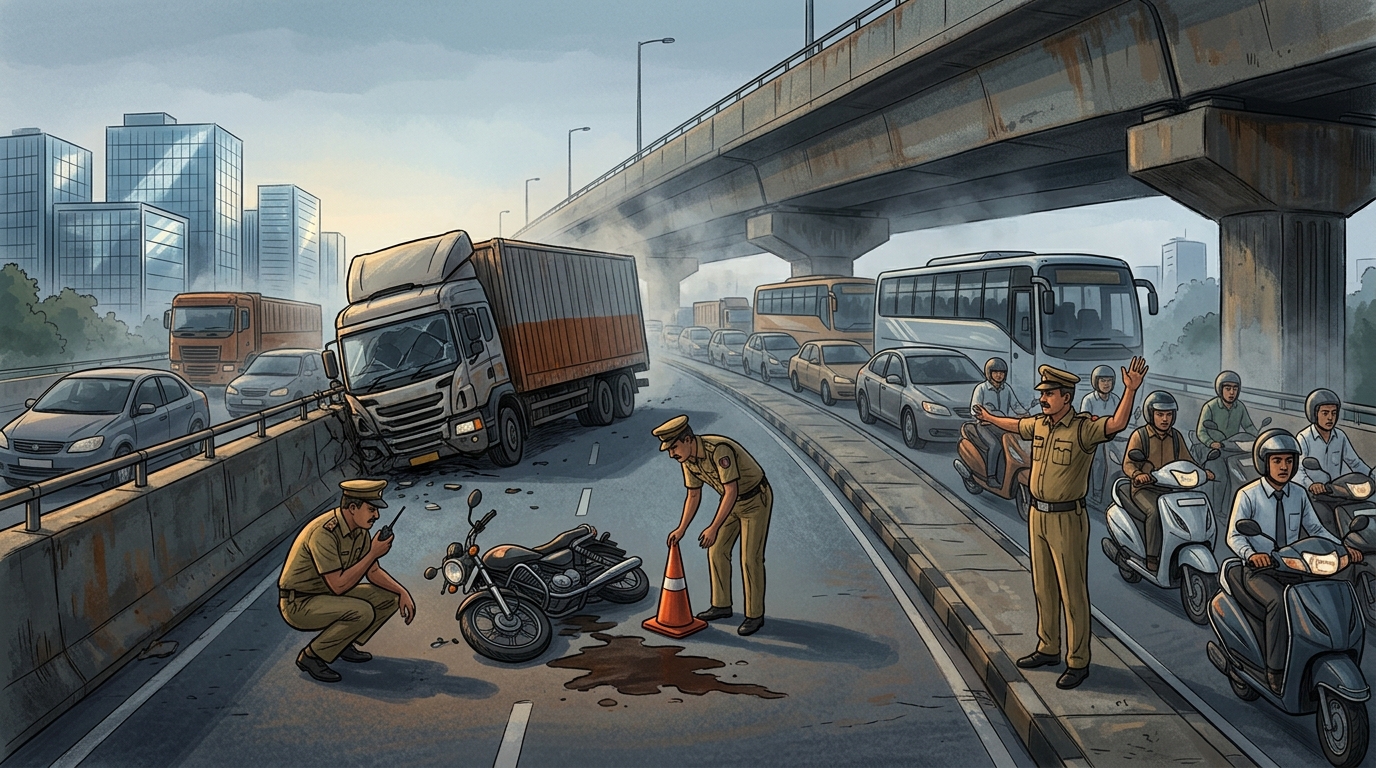
For Hyderabad's vast workforce of IT employees, startup founders, and corporate professionals who spend significant portions of their day navigating the city's arterial roads and flyovers, this week brought a sobering reminder of how fragile urban infrastructure safety can be. Two women lost their lives in a lorry collision on the Ongole Flyover, a tragedy that has once again thrust road safety governance into sharp focus — and raised hard questions about the pace at which civic authorities are addressing the city's mounting traffic and infrastructure challenges.
The Incident and What We Know
Police reached the site of the collision promptly, shifting the victims to a government hospital for post-mortem examination. A formal case has been registered and an investigation is underway. While the procedural response appears adequate on its face, the deeper concern for residents and daily commuters is not merely about this single incident — it is about the pattern it represents.
Hyderabad's rapid urban expansion, driven in no small part by the explosive growth of its IT and business districts in Hitec City, Gachibowli, and the Neopolis corridor, has placed enormous strain on road infrastructure. Flyovers and arterial connectors that were designed for a different traffic density now carry a far heavier load of private vehicles, commercial lorries, and public transport — often with inadequate signage, lane discipline enforcement, or structural maintenance audits.
A Systemic Problem, Not an Isolated Event
Road fatalities in Hyderabad are not aberrations. According to civic data tracked by GHMC and the Hyderabad Traffic Police, the city consistently records hundreds of road accident deaths annually, with a disproportionate toll falling on pedestrians, two-wheeler riders, and those travelling in smaller vehicles when collisions involve heavy goods vehicles.
The presence of heavy lorries on city flyovers — particularly during peak hours or without adequate time restrictions — is a policy and enforcement gap that GHMC and HMDA have been slow to address comprehensively. For business professionals who rely on these corridors to reach offices, client meetings, or the airport, this is not an abstract civic concern. It is a daily risk.
- Hitec City and Gachibowli commuters frequently navigate multi-lane flyovers shared with heavy commercial vehicles, particularly during early morning and late evening hours.
- Startup founders and investors travelling between the Financial District and the city centre use arterial routes where lorry traffic remains poorly regulated.
- Remote and hybrid workers who commute selectively may underestimate cumulative infrastructure risks that affect the broader urban ecosystem they depend on.
What Civic Accountability Looks Like — and Where It Fails
The GHMC and HMDA have in recent years announced multiple road safety and infrastructure upgrades, from smart traffic signal systems to flyover maintenance programmes. Yet the gap between announcement and sustained implementation remains wide. Investigations into individual accidents, while necessary, rarely translate into systemic reforms unless accompanied by public pressure and transparent reporting.
A genuinely worker-friendly and citizen-centred civic governance framework would treat every road fatality as a data point demanding structural response — not just a case to be filed and closed. It would mandate regular structural audits of flyovers, enforce time-based restrictions on heavy vehicle movement through urban corridors, and publish transparent safety records for major arterial routes.
What This Means for You
If you are an IT professional, entrepreneur, or business employee in Hyderabad, this incident is a prompt to engage more actively with local civic processes. Attend ward-level GHMC meetings, follow the Hyderabad Traffic Police's public grievance channels, and support civil society organisations that track road safety data. Your commute is not just a personal inconvenience — it is a shared infrastructure commons that deserves the same scrutiny you would apply to any system that affects your productivity, safety, and quality of life. Holding local civic bodies accountable is not someone else's job. In a city growing as fast as Hyderabad, it is everyone's.