With none of this week's major national headlines falling squarely within the domain of Indian economic policy, central government regulation, or pan-India industry trends, this edition of the NeopolisNews digest turns its full analytical attention to the one story with genuine, human-scale consequences for Indian citizens nationwide — including professionals from Hyderabad and Telangana who travel frequently for religious, personal, and business purposes: the devastating flash floods in Nepal that have left over 133 Indian nationals missing or unaccounted for.
What Happened
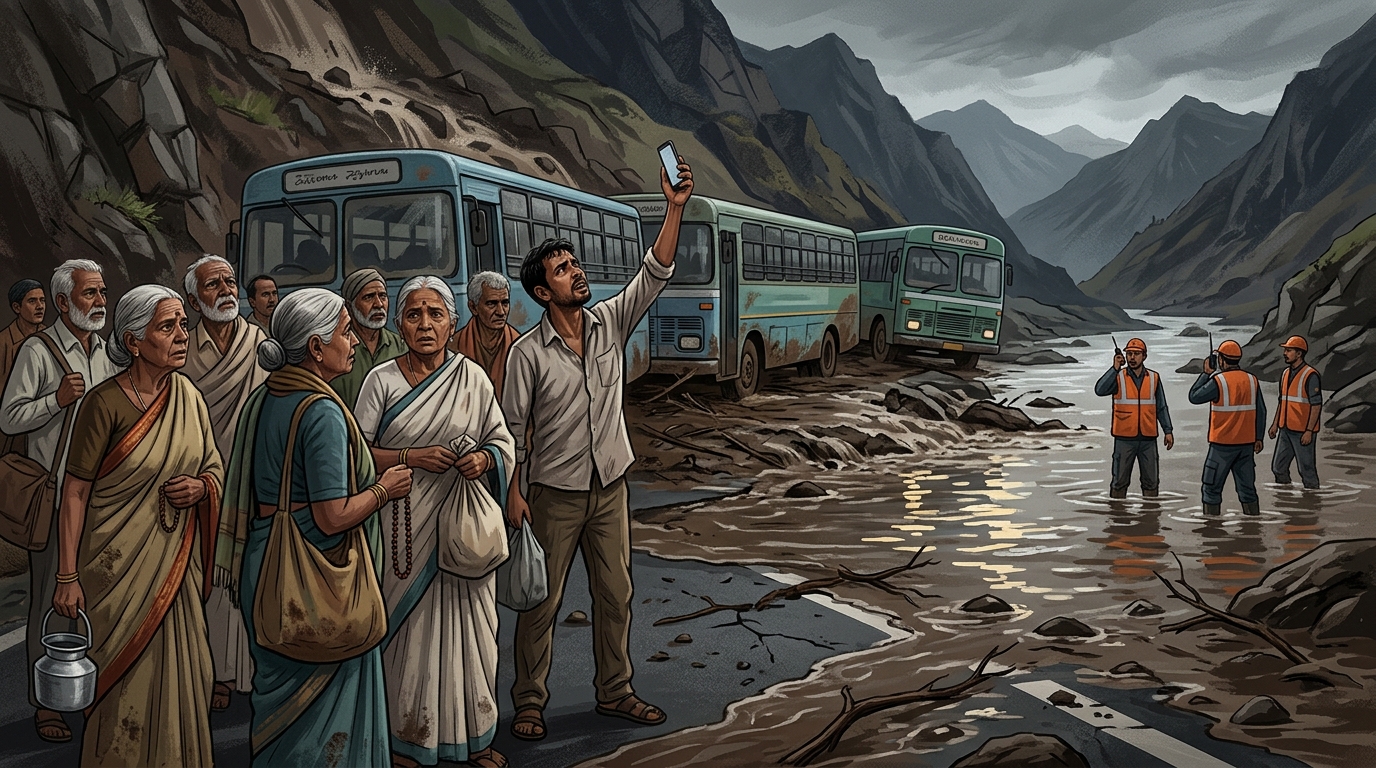
Flash floods originating in Tibet swept through central Nepal with little warning, killing more than 100 people and leaving upward of 750 missing. Among those unaccounted for are a 32-member group from Kolkata and a convoy of pilgrims from Tamil Nadu travelling in three buses toward Tibet. The scale of the tragedy is still unfolding, and families across India are in agonising uncertainty as emergency response teams struggle to reach affected areas.
Indian nationals travelling through Nepal for the Kailash Mansarovar Yatra — a pilgrimage that draws tens of thousands of devotees every year, including significant numbers from Andhra Pradesh and Telangana — are among the most vulnerable. This route passes through some of the most geologically fragile terrain in the world, and climate scientists have long flagged the increasing frequency and intensity of glacial lake outburst floods (GLOFs) in the Himalayan belt as a direct consequence of rising global temperatures.
A Structural Failure, Not Just a Natural Disaster
It would be a mistake to frame this solely as an act of nature. The Indian government maintains a formal framework for facilitating the Kailash Mansarovar Yatra through the Ministry of External Affairs, which means it carries an institutional responsibility for the safety of registered pilgrims. Questions being raised by affected families — about the adequacy of real-time weather advisories, the speed of diplomatic communication with Nepal and China, and the robustness of emergency evacuation protocols — deserve serious, public answers rather than bureaucratic deflection.
India's disaster response architecture, anchored by the National Disaster Management Authority (NDMA), has improved considerably over the past decade. But cross-border emergencies, which require multilateral coordination with Nepal, China, and local Tibetan Autonomous Region authorities, expose the limits of unilateral preparedness. The slow trickle of information reaching families in Tamil Nadu and West Bengal is itself a policy failure — one that a digitally connected government in 2025 has fewer excuses to repeat.
The Climate Thread Running Through This
Himalayan glacial instability is not a fringe concern. It is a documented, worsening phenomenon with life-and-death consequences for millions of people across South Asia. India's own glaciers feed the rivers that sustain agriculture, drinking water, and hydroelectric power for a substantial portion of the country. Every flood of this nature is a data point in an accelerating trend that demands both domestic climate policy ambition and aggressive multilateral engagement — areas where India's record remains, at best, mixed.
For Hyderabad's professional community, which includes a growing cohort of sustainability-focused entrepreneurs, ESG analysts, and technology professionals working on climate-adjacent platforms, this is a reminder that climate risk is not an abstraction. It is a present, operational reality with humanitarian dimensions.
What This Means for You
- If you travel for pilgrimages or trekking: Register formally with the Ministry of External Affairs before any Himalayan or trans-border journey. The MEA's eMigrate and travel registration systems exist precisely for crisis situations like this one — use them.
- If you have family participating in the Kailash Yatra or similar routes: Insist on comprehensive travel insurance that covers emergency evacuation from remote or cross-border terrain. Standard travel insurance often excludes such scenarios in fine print.
- If you work in tech, startups, or sustainability: The intersection of climate data, early-warning systems, and disaster communication is an underserved space in India's innovation ecosystem. The gaps exposed by this flood are gaps that thoughtful technology and policy can help close.
- For investors and founders: Climate resilience infrastructure — from early-warning platforms to logistics for crisis response — represents a growing area of impact investment that is also commercially viable. Watch this space.
The families waiting for news deserve more than sympathy. They deserve systemic accountability and a government that treats cross-border citizen safety as a standing infrastructure priority, not an emergency improvisation.