It has been a week that lays bare both the promise and the persistent dysfunction of Hyderabad's urban and administrative machinery. Three stories in particular demand the attention of anyone who lives, works, or builds a business in this city: the scandalous mishandling of the Telangana Group-III recruitment exam papers, the felling of 23 trees at the historic Paigah Palace compound in Begumpet to make way for underground parking, and the printing errors that have stalled smart ration card distribution in Medak district. Taken together, they sketch a portrait of a state government capable of grand ambitions but repeatedly tripped up by implementation failures — failures that carry real costs for real people.
Exam Papers as Snack Plates: A Recruitment System in Crisis
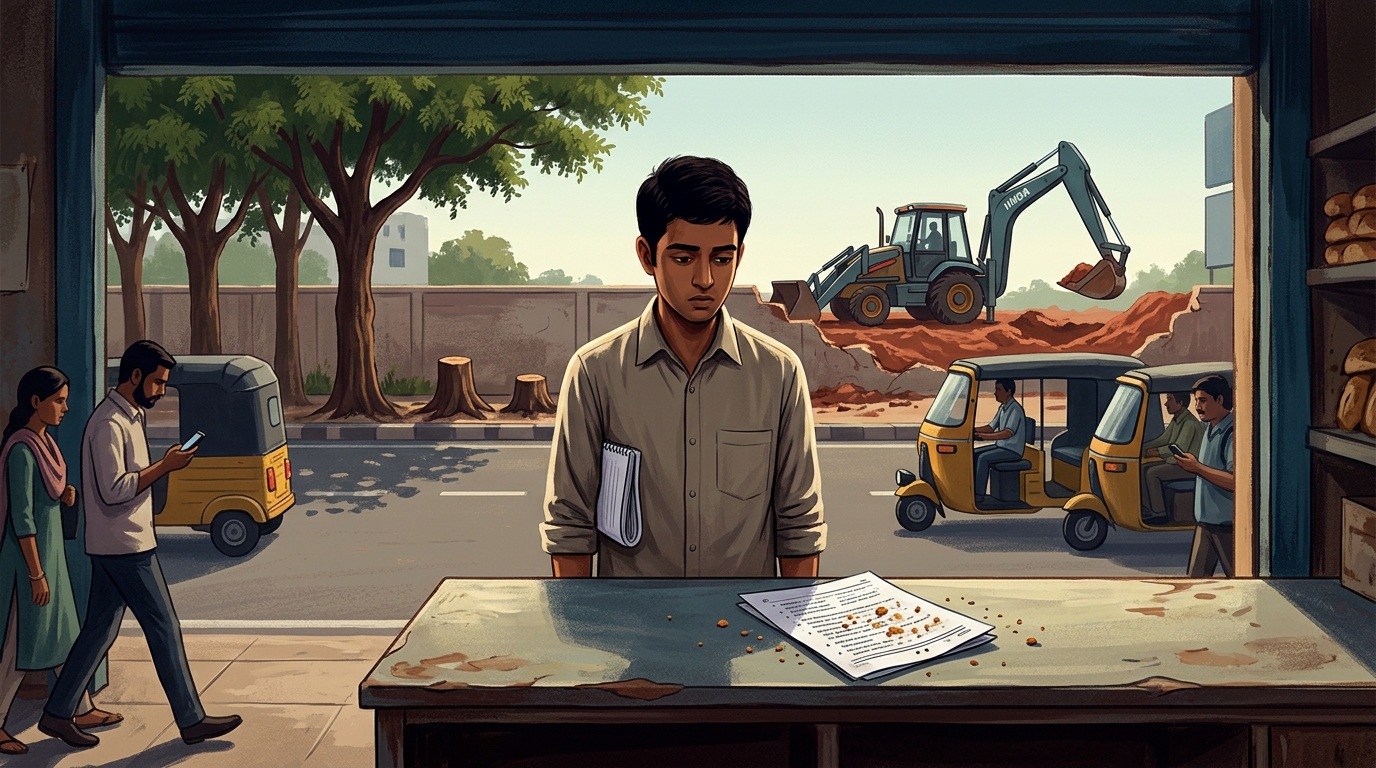
The image is almost too absurd to take seriously: question papers from the Telangana Group-III recruitment examination — a process that hundreds of thousands of aspirants from economically vulnerable backgrounds depend on for government employment — being used as disposable plates at a local bakery. And yet, this is precisely what residents discovered this week.
For Hyderabad's professional community, this may seem like a peripheral concern. It is not. The Group-III exams are a critical pipeline for filling mid-level state government positions — the clerks, data entry operators, and junior assistants who keep the administrative apparatus functioning. When that pipeline leaks, literally and figuratively, it signals deep institutional rot in procurement, logistics, and accountability chains. It also delays recruitment, leaving government departments understaffed — something that directly affects the speed of regulatory approvals, business registrations, and public service delivery that entrepreneurs and IT companies routinely navigate.
The TSPSC has faced repeated controversies over exam integrity in recent years. What is needed is not just a probe into this specific incident but a structural audit of how sensitive examination materials are handled, stored, and disposed of. Workers and aspirants who spend months preparing for these examinations deserve far better than this casual contempt for their efforts.
Paigah Palace's Green Cover Sacrificed for Parking
In Begumpet — one of Hyderabad's most commercially significant corridors, sitting between the IT districts and the old city — the Hyderabad Metropolitan Development Authority (HMDA) has removed 23 trees, including mature neem and mango trees, from the grounds of the iconic Paigah Palace to begin construction of a three-level underground parking facility.
HMDA says the trees will be translocated to Sanjeevaiah Park. Translocation of mature trees, however, has a notoriously poor survival rate, and the removal of established urban canopy in a heat-stressed city like Hyderabad is not a neutral act. Begumpet already bears the twin burdens of heavy traffic and rising urban heat island temperatures. For the thousands of professionals who commute through or work near this corridor daily, losing mature shade trees is a measurable deterioration in the quality of urban life.
There is also a broader philosophical question worth asking: is underground parking the right solution to Begumpet's congestion, or is it an infrastructure investment that will simply induce more private vehicle usage, defeating its own purpose? Progressive urban planning globally has moved toward improving public transit access and pedestrian infrastructure rather than accommodating ever-growing private car volumes. Hyderabad's Metro Rail already serves this corridor. The city's development authority should be asked, publicly and insistently, why expanding green commute incentives was not the first resort.
Smart Ration Cards, Dumb Errors: Medak Distribution Stalled
In Medak district, the rollout of smart ration cards — a digitisation initiative intended to reduce fraud and improve food security access — has been suspended after beneficiaries discovered significant printing errors. Cards in Variguntham carried the wrong village name; errors were also found in Toopran. Distribution has been halted while officials investigate.
This matters beyond Medak. The smart ration card system is a statewide public welfare infrastructure project. Its credibility depends entirely on accuracy and trust. Errors at this stage — in the physical cards that the most economically vulnerable families depend on for subsidised food access — reflect quality control failures that should not exist in a technology-forward state that markets itself as India's IT capital. For Hyderabad's startup and govtech community, this is also a cautionary data point: digitisation without rigorous quality assurance processes does not serve citizens; it burdens them.
What This Means for You
- IT and startup professionals: Administrative dysfunction in recruitment and public service delivery slows the government machinery your businesses interact with — from licensing to compliance. Advocacy for institutional reform is in your direct interest, not just civic virtue.
- Commuters and Begumpet-area workers: The loss of green cover in an already congested, heat-intensive corridor will worsen your daily commute environment. Track the HMDA project and demand transparent reporting on tree translocation survival rates.
- Entrepreneurs in govtech and civic tech: The Medak ration card fiasco is a case study in why public-sector digital projects need independent quality audits before rollout — and a potential opportunity to offer better solutions.
- Everyone: The Group-III exam paper scandal is a reminder that governance quality in Hyderabad is not just an abstract concern. It shapes who enters the public workforce, how efficiently government functions, and ultimately, the kind of city this is for everyone who lives and works here.