Three stories dominated the global stage this week, each carrying signals that extend well beyond their immediate geography — into the boardrooms, server farms, and career calculus of professionals in cities like Hyderabad that are deeply woven into the fabric of the global economy.
France in Flames: When Social Contracts Break Down
Curfews have been imposed across parts of central Paris and other major French cities following nights of widespread rioting. France's own interior minister admitted publicly that police had 'lost control' in several urban centres. In Marseille alone, shop owners reported over 600 premises looted, with cleanup crews arriving under continued police watch.
This is not mere street drama. France is the seventh-largest economy in the world and a critical node in European financial, luxury, and technology supply chains. When social unrest of this scale erupts in a G7 nation, it is almost always a symptom of deeper structural failures — inequality, marginalisation, and governance that has prioritised market stability over human dignity. The rioting follows a pattern visible across Western democracies: austerity-era resentments colliding with flashpoint events, producing ruptures that markets consistently underestimate until they cannot.
For IT and business professionals in Hyderabad, the implications are concrete. Several major Indian IT firms — including large system integrators — have significant delivery relationships with French enterprises and government clients. Supply chain disruptions, delayed procurement decisions, and heightened client risk-aversion in Europe are near-term possibilities. More broadly, political instability in core European markets tends to slow digital transformation budgets, as CFOs defer spending during uncertainty.
The deeper lesson, however, is one that progressive economists have long argued: economies that hollow out the middle class and fail to invest in public services eventually pay a far steeper price in social instability than they would have in welfare spending. It is a lesson relevant to every rapidly urbanising, inequality-prone economy — including our own.
Ukraine's Intelligence Gap: When Geopolitics Becomes a Matter of Life and Death
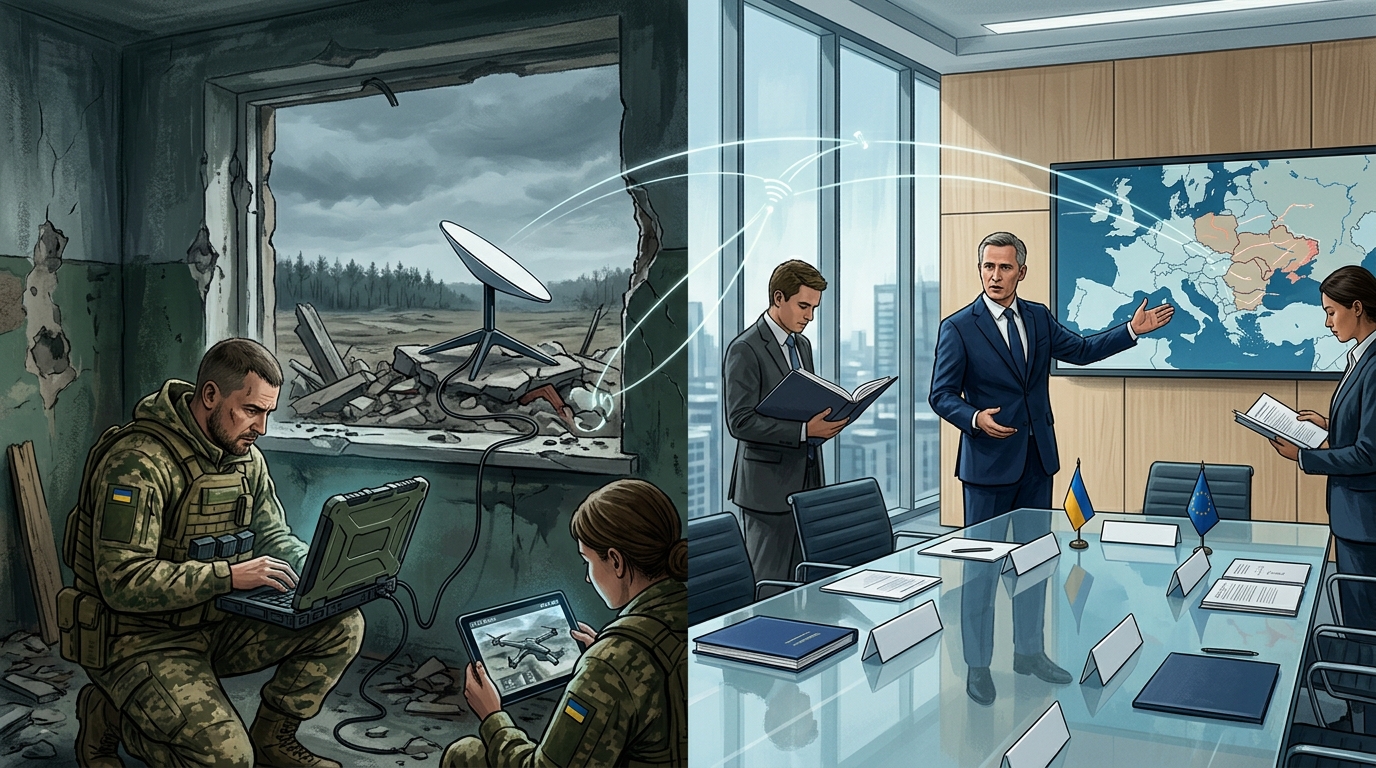
In a frank and troubling interview with the BBC, Serhii Beskrestnov, a senior adviser to President Zelensky, stated that Ukrainians are dying because the United States has been restricting intelligence sharing — specifically, that there has not been adequate warning time ahead of incoming Russian missile strikes. The White House denied any policy change, but the adviser's public statement itself marks a significant moment of diplomatic candour, or frustration, or both.
Regardless of where one stands on the geopolitics of the conflict, the humanitarian cost is undeniable. Civilians are dying in windows of warning that are measured in minutes. That a senior Ukrainian official felt compelled to say this publicly, to a global broadcaster, suggests the frustration inside Kyiv's leadership has reached a threshold.
For Hyderabad's professional community, the Ukraine war has already reshaped the world in measurable ways — energy prices, semiconductor supply chains, and the acceleration of defence-tech investment globally. A prolonged or escalating conflict introduces continued volatility in European energy markets, which in turn affects global inflation, central bank interest rate trajectories, and ultimately, the technology spending cycles that IT firms here depend upon. Cybersecurity professionals, in particular, should note that intelligence-sharing tensions between Western allies tend to correlate with periods of heightened state-sponsored cyberattack activity.
The Mars Moon Mission: Science as a Long Game
On a note that offers some respite from geopolitical grimness, a spacecraft has launched on an ambitious mission to retrieve approximately 10 grams of dust from Phobos, one of Mars's two moons. The mission represents a new frontier in sample-return science — the kind of long-horizon, high-risk, high-reward endeavour that the private space industry increasingly aspires to but that still largely depends on state-backed scientific institutions to pioneer.
For Hyderabad's growing aerospace and deep-tech startup ecosystem, missions like this are meaningful signals. They validate investment in planetary science instrumentation, materials science capable of surviving deep-space conditions, and the data infrastructure required to manage missions across hundreds of millions of kilometres. India's own ISRO has demonstrated that emerging economies can compete credibly in space — and missions like this raise the collaborative and competitive bar simultaneously.
What This Means for You
- IT Services Professionals: Monitor European client communications closely. French and broader EU client hesitancy on project approvals may increase in the near term. Use this period to deepen value delivery rather than chase new logos in affected markets.
- Startup Founders: The instability visible in France and Ukraine is accelerating investor interest in resilient, decentralised infrastructure — cybersecurity, edge computing, and crisis-response technology are areas with genuine tailwinds.
- Investors and Analysts: European market volatility warrants a cautious, selective approach. Defence-tech, cybersecurity, and space-adjacent deep-tech are sectors likely to see sustained public and private capital inflows globally.
- Deep-Tech and Aerospace Professionals: The Mars moon mission is a reminder that the scientific ambition driving next-generation space economies is intensifying. Upskilling in systems engineering, mission data analytics, or space-grade materials science is increasingly a career differentiator.
- Everyone: The French riots are a civilisational-scale reminder that no amount of GDP growth substitutes for social cohesion. Equitable growth is not a luxury — it is infrastructure.