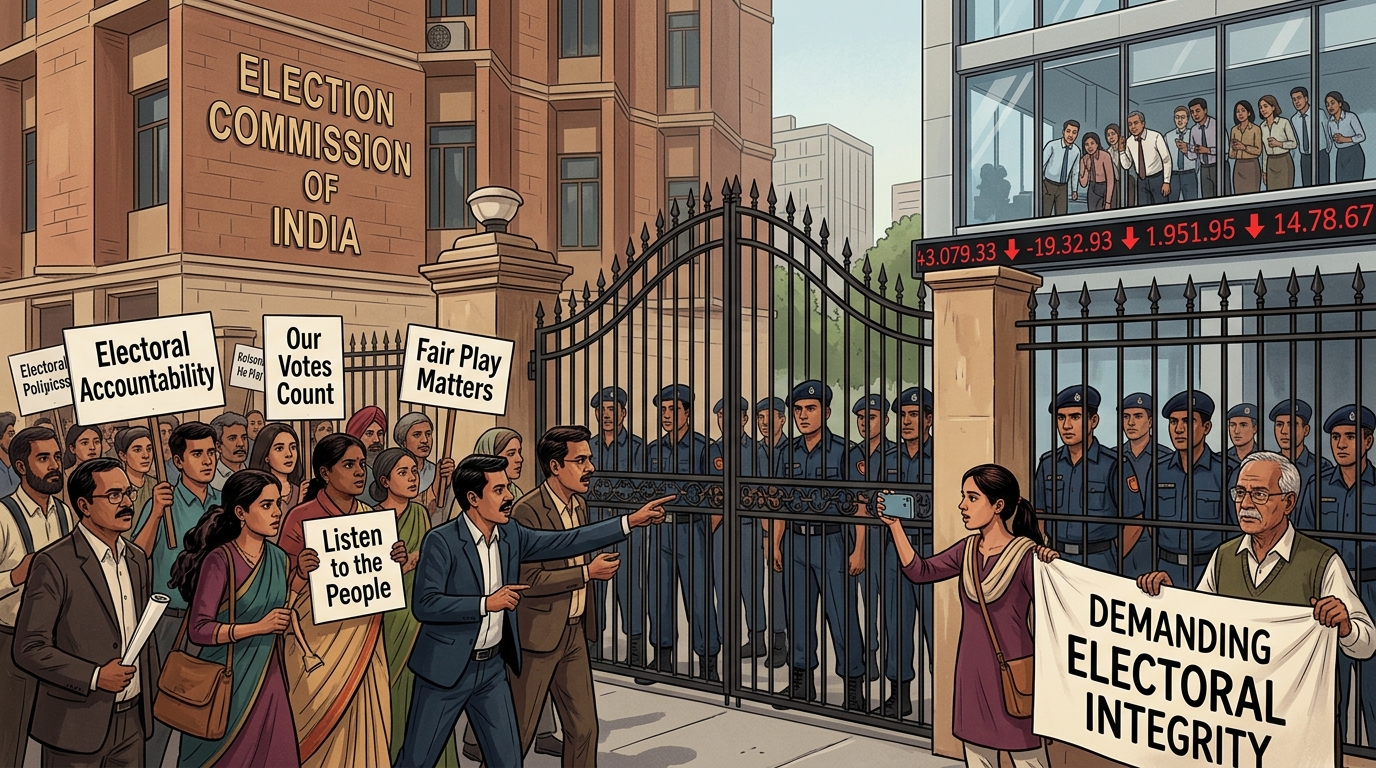
Two Developments Demand Attention Today
We owe our readers a correction and an apology. An earlier version of today's digest stated that no India-wide headlines fell within our editorial scope. That was an editorial oversight. Two significant national developments are unfolding today that are directly relevant to Hyderabad's business, investment, and IT professional community: a high-profile democratic accountability protest at the Election Commission of India, and a broad market selloff that is hitting equity portfolios across the country.
CJP Protest at the Election Commission of India
Citizens for Justice and Peace (CJP), one of India's most prominent civil liberties organisations, is staging a major protest at the Election Commission of India today. While the precise demands being raised are still being reported in full, CJP's interventions have historically centred on electoral transparency, voter roll integrity, and the constitutional independence of the Commission from executive influence.
For professionals in Hyderabad's business and IT ecosystem, this matters beyond the political optics. A credible, independent Election Commission is foundational to policy continuity and investor confidence. When civil society organisations of CJP's stature publicly challenge the Commission's conduct, it raises legitimate questions about institutional trust — questions that rating agencies, foreign institutional investors, and domestic fund managers do factor into their medium-term India outlook. Democratic accountability and economic stability are not separate conversations; they are deeply linked.
This is also a story about worker and citizen rights. The ability of civil society to hold constitutional bodies accountable without intimidation is a marker of the kind of institutional environment in which professionals, entrepreneurs, and employees can plan long-term futures.
Stock Markets Under Pressure
Indian equity markets are experiencing a significant downturn today. Both the BSE Sensex and NSE Nifty 50 are trading sharply lower, reflecting a combination of domestic uncertainty and broader risk-off sentiment. For Hyderabad's large community of IT sector employees with ESOP holdings, mutual fund SIPs, and equity portfolios, this is a session that warrants careful attention — though not necessarily panic.
Market corrections of this nature tend to concentrate pain in mid-cap and small-cap segments, which have seen elevated valuations over the past 18 months. Professionals holding diversified index funds are better cushioned than those with concentrated sectoral bets, particularly in rate-sensitive segments.
- SIP investors: Volatile sessions are precisely when systematic investment discipline pays off. Avoid pausing SIPs during drawdowns — rupee-cost averaging works in your favour here.
- ESOP holders: If your vesting schedule is approaching, consult your tax advisor on whether a volatile NAV date affects your tax liability calculation.
- Startup founders and CFOs: A risk-off equity environment typically tightens early-stage funding sentiment within two to four weeks. Monitor your runway assumptions accordingly.
The Broader Picture
Taken together, today's two developments — a civil society challenge to a constitutional body and a rattled equity market — are not unrelated. Institutional uncertainty, when it becomes visible and public, contributes to the sentiment environment in which markets operate. India's long-term growth story remains structurally intact, but short-term volatility is being fed by a confluence of political and economic signals that professionals here should track closely.
NeopolisNews will continue to update this story as further details emerge from the Election Commission protest and as market closing figures become available. We regret the earlier omission and thank readers whose feedback ensured we corrected course promptly.