For Hyderabad's working professionals — many of whom are parents, taxpayers, and stakeholders in the region's long-term growth — this week's Telangana developments offer a mixed but telling picture of where the state is headed on education, political accountability, and inclusive governance.
13,000 Schools Upgraded: A Talent Pipeline Investment Worth Watching
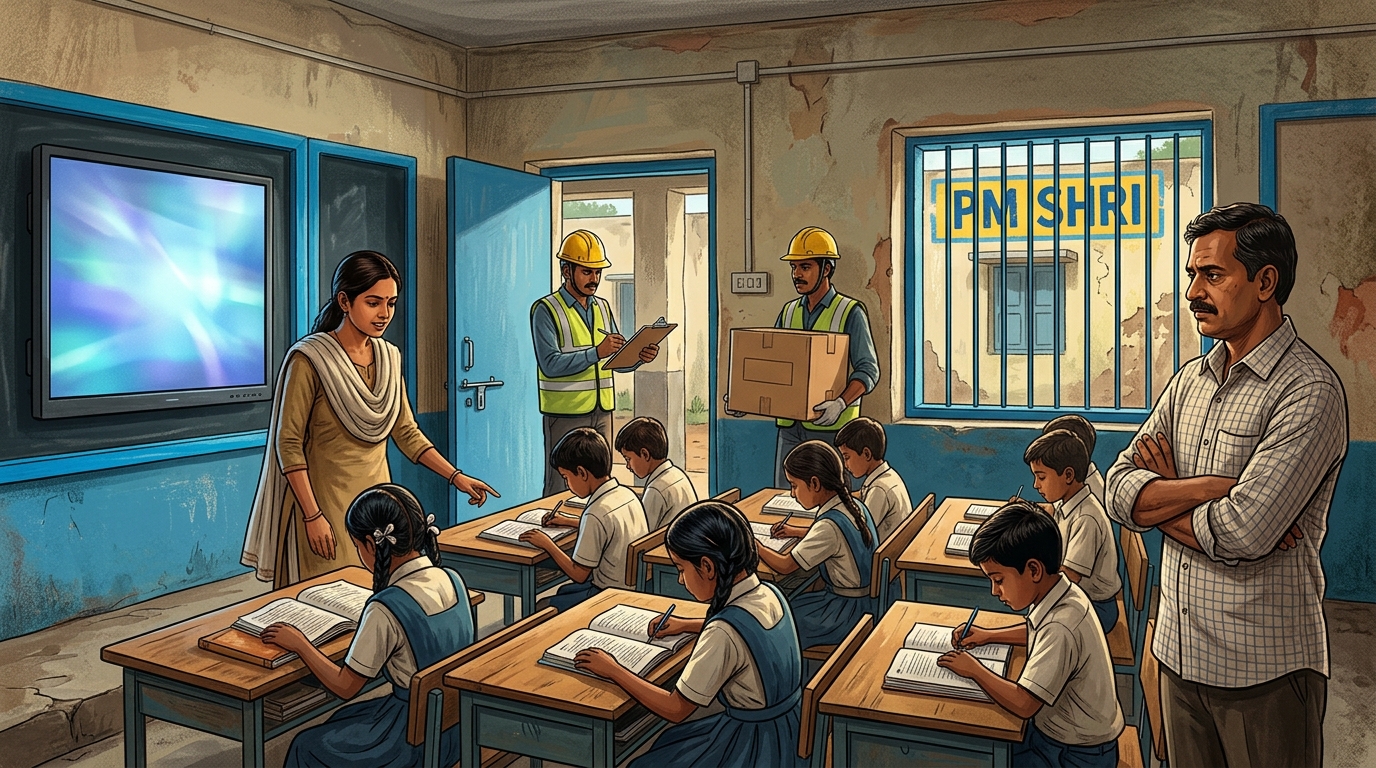
The most consequential development for the region's future workforce is the ongoing revamp of over 13,000 schools under the PM SHRI (PM Schools for Rising India) scheme, which aims to benefit more than 20 lakh students across Telangana. These institutions are being redesigned as model schools aligned with the National Education Policy (NEP) 2020 — emphasising experiential learning, digital infrastructure, and multilingual pedagogy.
For IT professionals and startup founders who routinely lament the skills gap in entry-level hiring, this matters. The quality of government school education in Telangana directly shapes the talent that flows into degree colleges, engineering institutions, and eventually into the tech workforce a decade from now. If these upgrades are implemented with genuine infrastructure investment — and not just cosmetic renovation — they could meaningfully expand the pool of first-generation professionals entering Hyderabad's economy.
The critical caveat, however, is implementation. Telangana has a mixed record on translating centrally-funded education schemes into ground-level change. Professionals and civil society would do well to demand transparent, ward-level progress reporting on where these funds are actually going.
BRS Attacks Congress on Tribal Promises: A Governance Credibility Question
The Bharat Rashtra Samithi (BRS) has sharply criticised the ruling Congress government for allegedly failing to fulfil electoral commitments to Scheduled Tribe communities — including financial assistance packages, reservation expansions, and the regularisation of Podu land holdings. Former ministers from BRS have framed this as a pattern of political betrayal.
While this is opposition politics, the substantive issue deserves attention beyond partisan noise. Podu land rights — covering forest-adjacent agricultural lands cultivated by tribal communities — have been a long-pending and deeply human question in Telangana's governance. A failure to resolve these equitably has downstream consequences: land insecurity drives distress migration, weakens rural consumption, and ultimately narrows the base of Telangana's economic growth beyond Hyderabad's IT corridors.
For entrepreneurs building in agri-tech, rural fintech, or social impact sectors, the political will — or lack thereof — to address tribal land rights is both an ethical and a market signal. Unresolved land tenure issues create legal ambiguity that complicates investment and operations in interior Telangana.
HCA Under-19 Cricket: A Small but Meaningful Signal
The Hyderabad Cricket Association's Under-19 Super League, which saw strong performances including unbeaten centuries from P. Charan Tej and S. Guru Vidhwan, may seem tangential to a business digest. But organised youth sport at this level reflects something important: institutional investment in structured pathways for young talent outside of academics. For a city increasingly defined by its professional ambitions, the health of youth sporting culture is part of the broader quality-of-life equation that determines whether top talent chooses to stay in Hyderabad or migrate to Bengaluru, Pune, or abroad.
What This Means for You
- Parents and education stakeholders: Track the PM SHRI school upgrades in your district or ward. Demand ward-level disbursement data from local corporators and the state education department. The quality of these reforms will shape your city's talent supply chain.
- Entrepreneurs in rural or agri-tech sectors: The unresolved Podu land and tribal welfare commitments represent both a governance gap and an opportunity. Businesses that can operate with clear community consent frameworks in tribal regions will be better positioned as land policy eventually gets resolved.
- Civic-minded professionals: The BRS-Congress debate over tribal promises is a reminder that Telangana's political economy extends far beyond HITEC City. A state that fails its most marginalised communities is building prosperity on an unstable foundation — and that instability eventually reaches the urban professional too, through labour markets, consumption patterns, and social cohesion.
- General professionals: None of this week's in-scope Telangana news suggests immediate market disruption, but the education investment story is the one to follow long-term — it is, arguably, the most important infrastructure project the state can run.