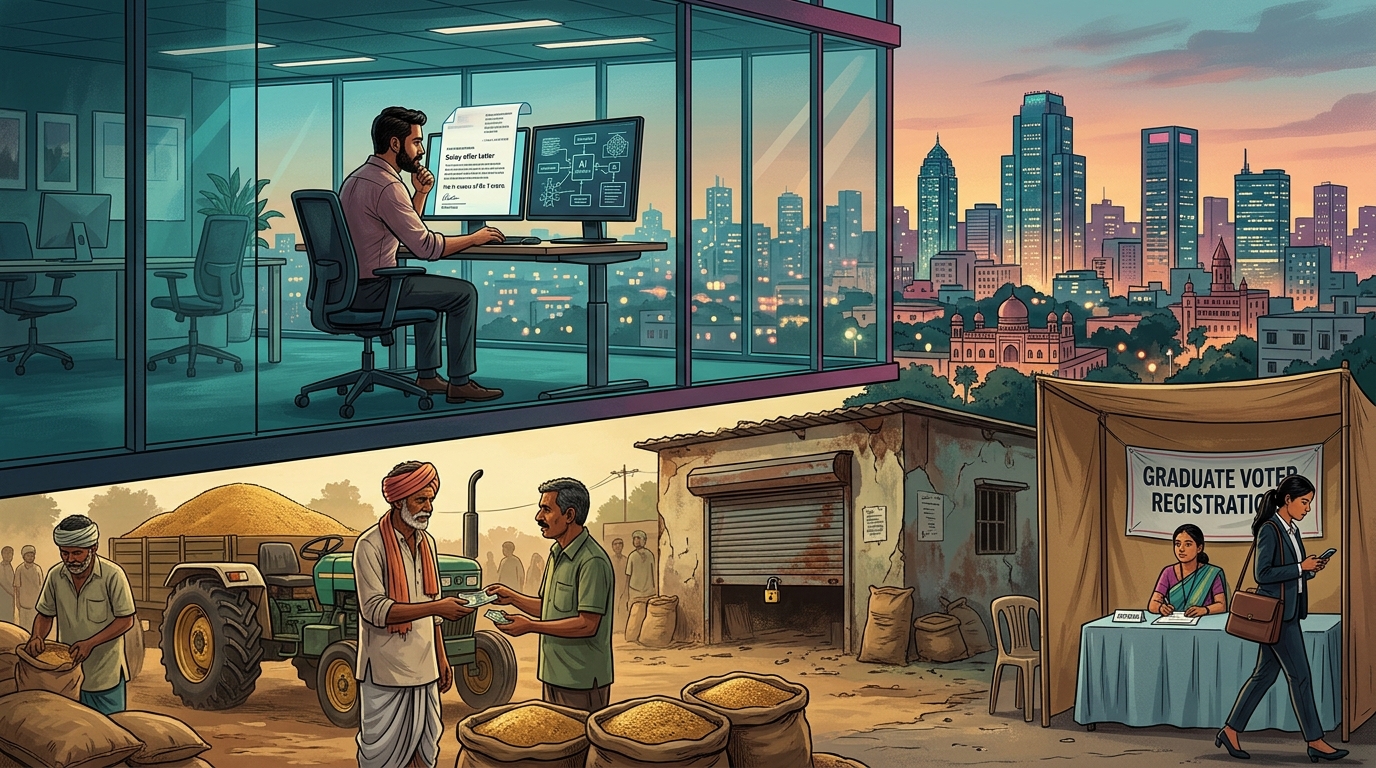
Three distinct but interconnected stories are shaping Telangana's week — a striking salary premium for AI professionals in Global Capability Centres, a quiet but consequential failure in state paddy procurement, and a worrying gap in democratic participation among Hyderabad's educated workforce. Together, they paint a portrait of a state navigating rapid economic transformation while grappling with stubborn structural gaps in governance and civic life.
AI Professionals in Hyderabad's GCCs Are Commanding Record Pay — But the Gains Are Narrow
A new TeamLease Digital report confirms what many in Hyderabad's tech circles have sensed: the shift toward AI-led operations inside India's Global Capability Centres is accelerating fast, and compensation is following. AI architects are now earning up to Rs 1.08 crore annually at GCCs — many of which are headquartered in Hyderabad's HITEC City and Financial District corridors.
This is genuinely significant news for tech professionals in the city. Roles in machine learning engineering, data architecture, and AI product management are commanding salary premiums that were unthinkable even three years ago. For mid-career IT employees — particularly those in the 5-to-10-year experience bracket — this represents a real and actionable opportunity, provided they are willing to invest in upskilling.
However, a note of caution is warranted. Salary premiums at the top of the AI pyramid do not automatically translate into broad-based wage growth across Telangana's IT workforce. The risk is a deepening bifurcation: a small cohort of highly specialised AI professionals earning generational wealth, while large sections of the software services workforce face stagnating compensation or displacement through automation. Policymakers at the Telangana IT department and industry bodies like T-Hub would do well to invest in reskilling pipelines — not just celebrate the headline numbers.
Paddy Procurement Failure Has Real Consequences for Hyderabad's Cost of Living
Away from the gleaming towers of Madhapur, a slower-burning crisis is unfolding in Telangana's agricultural districts. State paddy procurement is lagging significantly behind targets, with private traders stepping in to buy directly from farmers — bypassing the state's public procurement mechanism.
The consequences are already visible. Fine rice prices have risen in several districts, and if procurement gaps persist, urban consumers — including the millions of salaried workers and their families in Hyderabad — could face higher food costs in the months ahead. Food inflation disproportionately affects lower-income households and contract workers, who spend a larger share of their earnings on essentials.
This is also a structural concern. When private traders dominate procurement, they gain pricing power over both ends of the supply chain — squeezing farmers on purchase prices and consumers on retail prices. The state's public buffer stock system exists precisely to prevent this dynamic. A weakened procurement apparatus is not a minor administrative hiccup; it is a failure with tangible distributional consequences.
The Telangana government owes citizens a clear accounting of why procurement is lagging, what stocks are actually in reserve, and what the plan is to stabilise fine rice prices before the situation worsens.
Graduate Voter Registration in Hyderabad: A Democratic Deficit Worth Taking Seriously
BRS deputy floor leader Talasani Srinivas Yadav has raised an issue that cuts across partisan lines: with only around 23,000 graduate voter applications received so far for the Hyderabad Graduate constituency, the city's educated professional class remains dramatically underrepresented in one of Telangana's most consequential electoral exercises.
Graduate MLC constituencies exist specifically to give educated citizens a direct legislative voice. That Hyderabad — home to hundreds of thousands of engineers, managers, startup founders, and corporate employees — has such thin graduate voter rolls is an indictment not just of the Election Commission's outreach, but of civic disengagement within the professional community itself.
The reasons are not hard to understand. Long working hours, unfamiliarity with the registration process, and a sense that individual participation does not matter all contribute to low enrolment. But the stakes are real: graduate MLCs influence policy discussions on education, employment, and urban governance — areas that directly affect this very community.
What This Means for You
- If you work in IT or a GCC: The AI salary surge is real, but selective. Identify where your skills sit on the AI readiness spectrum and consider structured upskilling now — not after the window narrows further.
- As a Hyderabad resident and consumer: Monitor fine rice and food grain prices over the coming weeks. The paddy procurement gap is a supply-side signal worth watching, especially if you manage a household budget or run a food-related business.
- As a graduate professional and citizen: Check whether you are registered as a graduate voter in Hyderabad. The deadline windows for MLC elections are limited. Registration takes under an hour and gives you a vote in a constituency designed specifically for people like you — use it.