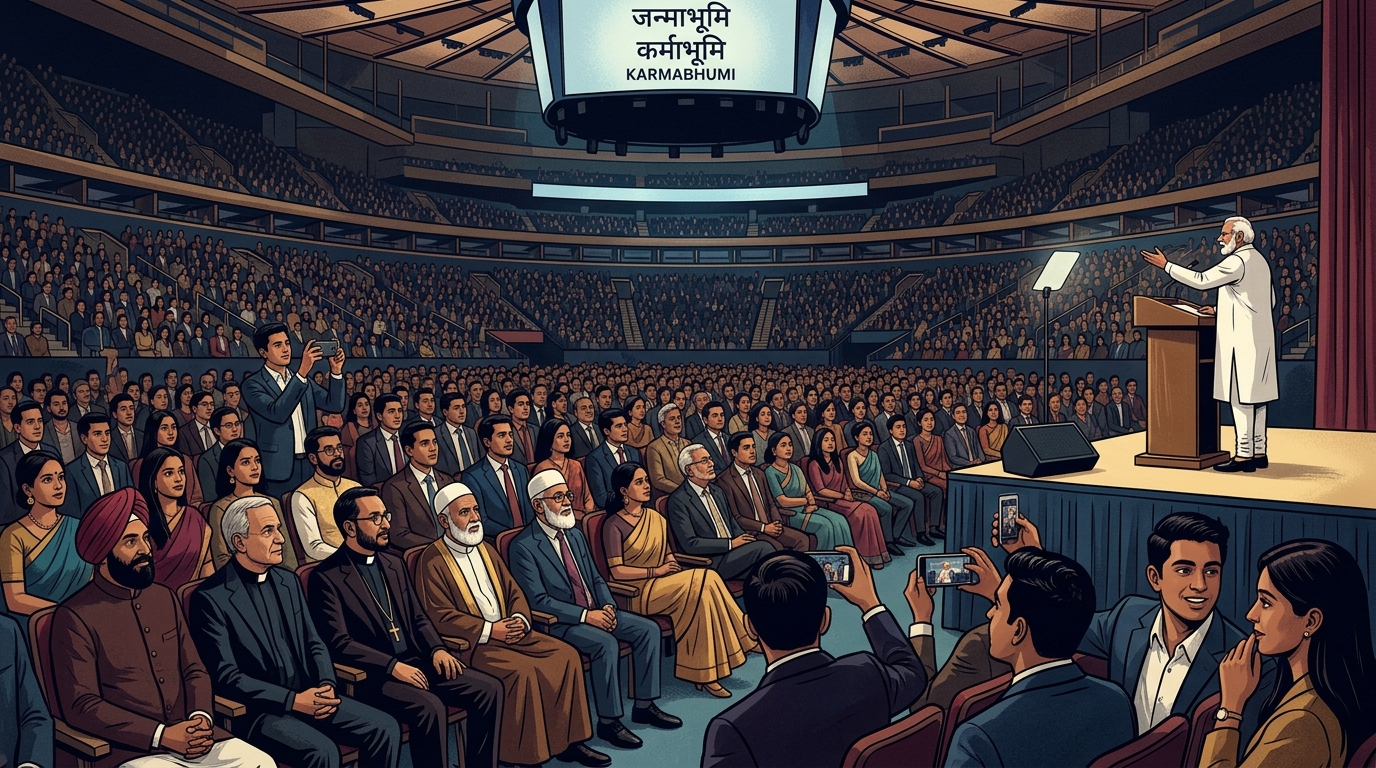
This week, India's political and cultural leadership made its presence felt on the world stage — with RSS chief Mohan Bhagwat addressing thousands of Indian-Americans at Madison Square Garden, and Prime Minister Narendra Modi receiving a warm welcome in Uzbekistan. While neither event originates on Indian soil, both are exercises in statecraft and soft power that carry tangible implications for India's professional class, particularly those in knowledge industries and globally connected businesses.
Bhagwat at Madison Square Garden: Culture, Identity, and the NRI Economy
Mohan Bhagwat's address to approximately 5,000 Indian expatriates at Madison Square Garden — framed around the theme of Janmabhumi (land of birth) and Karmabhumi (land of work) — was notable for its optics as much as its content. With religious leaders from multiple faiths seated in the front row, the event projected a message of pluralism, even as it emerged from an organisation historically associated with Hindu nationalist politics.
For India's IT and business community, the relevance is not ideological but economic. The Indian-American diaspora represents one of the most influential lobbying and investment blocs in the United States — a community that channels billions in remittances, venture capital, and mentorship back to India. Events that strengthen diaspora identity and institutional ties can, over time, reinforce networks that benefit startups seeking US market entry, engineers exploring return migration, and founders courting Silicon Valley funding.
However, it is worth noting that the conflation of cultural nationalism with economic opportunity deserves scrutiny. Diaspora engagement is most productive when it is inclusive and builds genuine bridges — not when it serves narrow political consolidation. The framing of Karmabhumi also raises a pointed question: if India wants its best minds to return and contribute, are domestic conditions — wage growth, labour protections, quality of public services — keeping pace with the aspiration?
Modi in Uzbekistan: Central Asian Connectivity and India's Trade Ambitions
Prime Minister Modi's visit to Uzbekistan, marked by cultural diplomacy including Kathak performances by the Indian diaspora, is part of India's sustained effort to deepen ties with Central Asian nations. Uzbekistan sits at a critical juncture of the International North-South Transport Corridor (INSTC) and India's broader Connect Central Asia policy.
For India's IT sector and logistics-adjacent businesses, Central Asian connectivity is an emerging frontier. As Indian companies look beyond traditional Western markets for software exports, BPO contracts, and digital infrastructure projects, nations like Uzbekistan — which are modernising rapidly and hungry for technology partnerships — represent meaningful mid-term opportunity. The diplomatic groundwork being laid today often translates into government-to-government IT contracts and private sector deals within a three-to-five year horizon.
India's engagement with Uzbekistan also signals a continued push toward multipolarity in trade relationships — reducing overdependence on the US-Europe axis. For entrepreneurs in Hyderabad's startup ecosystem, this is worth watching: new trade corridors can open new customer bases, especially in fintech, edtech, and health technology, where Indian firms have proven competitive.
A Note on What Is Missing from This Week's Headlines
It is striking that this week's national news cycle has been dominated by diplomatic optics and diaspora events rather than substantive domestic policy announcements — particularly on economic or labour fronts. There has been no major RBI guidance, no central budget revision, and no significant SEBI regulatory update this week. For professionals tracking monetary policy, credit conditions, or startup regulation, the silence is itself informative: the government's attention, at least in its visible communications, is outward-facing.
What This Means for You
- IT professionals with US aspirations: Stronger diaspora networks, reinforced by high-profile events like the Madison Square Garden gathering, can organically improve mentorship access and referral pipelines to US-based Indian-origin hiring managers and investors. Nurture those networks actively.
- Startup founders seeking new markets: Modi's Central Asia push is a signal to explore Uzbekistan, Kazakhstan, and neighbouring markets for SaaS, edtech, and digital payments opportunities. Government trade bodies like NASSCOM and FIEO may soon announce facilitation programmes aligned with this diplomatic momentum.
- Investors and analysts: The absence of major domestic policy news this week suggests a relatively stable near-term regulatory environment. However, monitor RBI communications closely — any shift in interest rate posture will directly affect startup valuations and credit availability for SMEs.
- All professionals: As India projects confidence abroad, the domestic ask — better public infrastructure, fair wages, and equitable growth — must not be allowed to fade from the policy conversation. Engagement with industry bodies and civil society remains essential to keep that pressure alive.