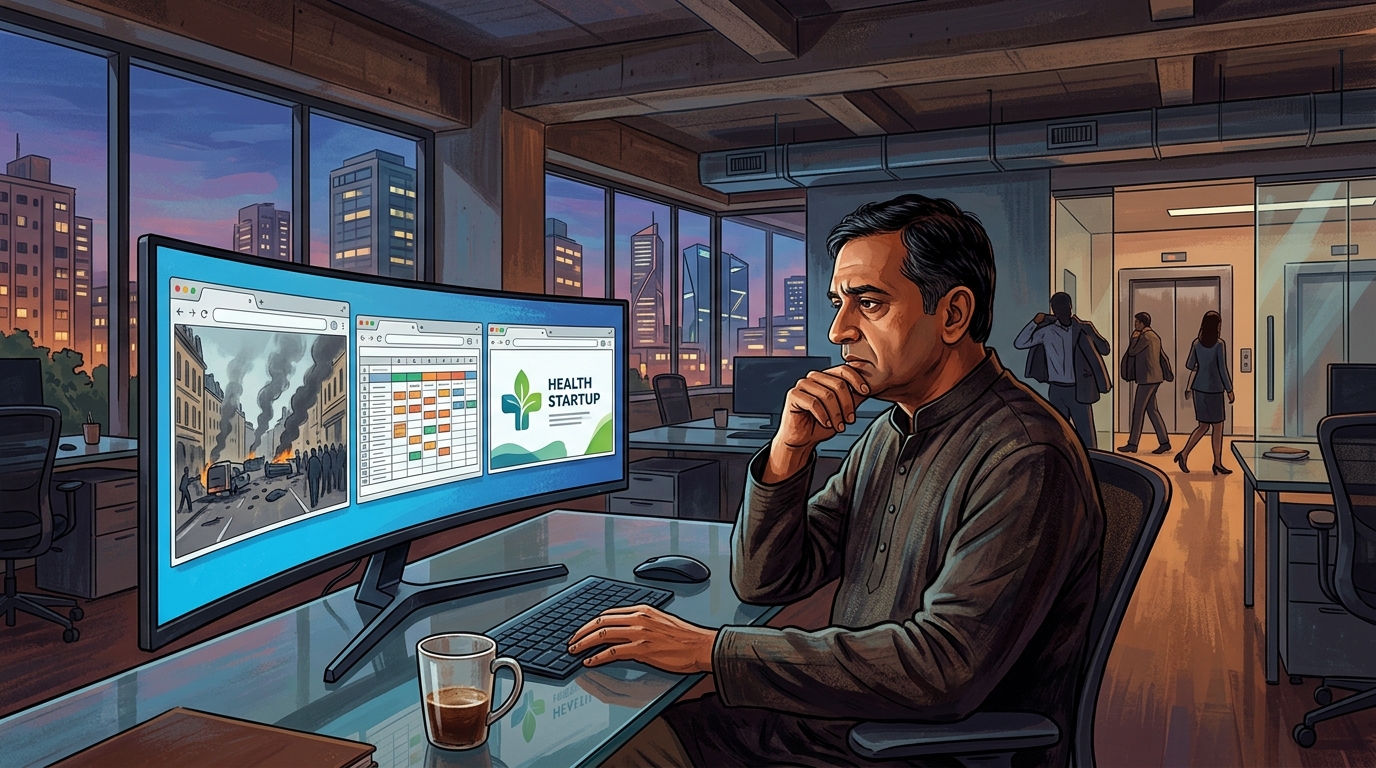
Three seemingly unconnected stories — a deadly drone strike on a Ukrainian shopping centre, a climate warning about the most powerful El Niño in living memory, and a high-profile privacy case verdict in Britain — converged this week to sketch a world under compounding stress. For Hyderabad's business and IT community, each carries consequences that go beyond the headlines.
Ukraine: The Human and Economic Cost of a Prolonged War
A Russian double-tap drone strike — a tactic that involves a second strike timed to hit emergency responders — killed at least 15 people and injured more than 130, including 23 children, at a shopping mall in Ukraine. The deliberate targeting of civilian infrastructure is not merely a war crime allegation; it is a signal of strategic intent to grind down Ukrainian civil society and economic capacity.
For global technology and business professionals, the war's persistence continues to exert pressure on energy markets, semiconductor logistics, and Eastern European IT outsourcing corridors. Ukraine was a significant source of software engineering talent for European firms — and continued conflict means that displacement of skilled workers persists, subtly reshaping the global technology talent map. Indian IT majors with European delivery centres are already navigating energy cost volatility linked to this conflict. A prolonged war keeps that instability alive.
The double-tap strike also reignites debate at the UN Security Council about accountability mechanisms for attacks on civilian infrastructure — debates that, if they produce any meaningful international response, could reshape defence-tech investment priorities globally, an area where Indian startups are increasingly active.
El Niño: The Climate Risk Your Business Plan May Not Have Priced In
The UK's Met Office has issued a stark warning: the El Niño phenomenon developing over the Pacific Ocean is likely to be the strongest in living memory. El Niño — a periodic warming of Pacific surface temperatures — disrupts global weather patterns with cascading effects: droughts in some regions, floods in others, and in almost every case, agricultural and supply chain disruption.
The last major El Niño event (2015–16) contributed to food price inflation across Asia, disrupted hydropower generation, and triggered insurance losses of hundreds of billions of dollars globally. A stronger event this time carries proportionally greater risk.
For Hyderabad's IT and business professionals, the implications are layered. Cloud infrastructure providers — the backbone of the SaaS products and platforms that the city's tech sector builds upon — rely heavily on stable energy grids. Extreme weather events driven by El Niño strain power infrastructure globally. Data centre cooling costs spike during heat anomalies. More concretely, global food price inflation — which El Niño historically accelerates — squeezes household budgets and dampens consumer spending, softening the markets that tech products serve.
For startup founders building climate-tech, agri-tech, or supply chain solutions, this is simultaneously a warning and a market signal. The climate risk premium is no longer theoretical — it is actuarial. Investors are increasingly pricing climate exposure into valuations, and founders who do not have a credible climate risk assessment in their pitch decks will find conversations with serious institutional capital harder.
The UK Privacy Ruling: A Lesson in Digital Rights and Corporate Power
A British court ruled against Prince Harry, Sir Elton John, Liz Hurley, and four other claimants in a privacy case against Associated Newspapers, the publisher of the Daily Mail. The claimants — who alleged unlawful information gathering — must now pay an initial legal bill of £9.54 million, with total exposure potentially reaching £34.5 million.
Stripped of its celebrity veneer, this case carries a significant structural message: even well-resourced individuals with credible privacy grievances can find themselves on the wrong side of a legal system that tends to favour established media institutions. The case underscores the yawning gap between aspirational privacy rights and enforceable privacy protections — a gap that matters enormously to professionals in the digital economy.
India's own Digital Personal Data Protection Act is still bedding in, and the UK verdict serves as a cautionary tale about how difficult it is to hold powerful data-handling organisations accountable even under mature legal frameworks. For Hyderabad's IT professionals — many of whom work on platforms that handle sensitive user data — this is a reminder that compliance is not the same as ethics, and that building genuine data privacy into product architecture is both a moral and a long-term business imperative.
What This Means for You
- IT professionals in European-facing roles: Monitor energy cost volatility and talent availability shifts linked to the Ukraine conflict. Eastern European developer displacement may create short-term opportunities but also pricing pressures.
- Startup founders: If your pitch deck does not address climate risk — especially El Niño-driven supply chain and energy disruptions — add it now. Institutional investors, particularly those with ESG mandates, will ask.
- Product and engineering teams: The UK privacy ruling is a reminder that strong data privacy is a competitive differentiator, not just a compliance checkbox. Architect for privacy by default, not as an afterthought.
- Investors and fund managers: Climate-exposed sectors — agriculture, logistics, energy — face elevated volatility this cycle. El Niño forecasts should inform portfolio stress-testing ahead of the next two to three quarters.
- Everyone: The targeting of civilian infrastructure in Ukraine is a reminder that geopolitical risk is not abstract. Business continuity planning for global operations must account for conflict-driven disruptions as a baseline scenario, not an edge case.