For Hyderabad's working professionals, this week's news cycle carries a deceptively quiet urgency. On the surface, headlines about satellite launches and water supply feel distant from the concerns of someone debugging code in Gachibowli or pitching investors in Hitec City. Look closer, and the connections are hard to ignore.
ISRO's Return: A Signal for Hyderabad's Deep-Tech Ecosystem
ISRO's successful return to action at Sriharikota — launching EOS-05, a replacement for the GISAT-1A satellite lost in the 2021 launch failure — is more than a national space headline. For Hyderabad, which has quietly emerged as one of India's most active hubs for space-tech startups and geospatial analytics firms, a resurgent ISRO matters commercially.
Companies like Skyroot Aerospace, MapmyIndia's Hyderabad operations, and a growing cluster of remote-sensing and earth-observation startups around the Genome Valley and HITEC City corridors are directly tied to ISRO's data infrastructure and launch cadence. EOS-05's primary mission — earth observation — feeds into agriculture monitoring, urban planning, and disaster management applications, all sectors where Hyderabad-based firms are actively building products.
A functioning, reliable ISRO pipeline also strengthens the investment case for deep-tech founders seeking early-stage funding. Venture capitalists scanning the space-tech vertical tend to price in launch reliability as a systemic risk. ISRO roaring back reduces that risk premium, even marginally.
Water Scarcity: The Infrastructure Story Hiding in Plain Sight
The more locally pressing story this week is the compounding water stress narrative. The Andhra Pradesh Chief Minister's emergency directive to Cabinet officials — to prevent potable water shortages and ensure crop protection — comes alongside news that Krishna water may not reach the Chittoor region until after September 10. While these stories are geographically centred outside Hyderabad's city limits, they are structurally inseparable from the pressures building inside them.
Hyderabad's rapid, often poorly planned expansion into areas like Shamshabad, Shadnagar, and the outer ring road corridor has created residential and commercial zones that are deeply vulnerable to water supply disruptions. The city's IT campuses — particularly the larger SEZ developments in Gachibowli and Nanakramguda — rely on stable water infrastructure for cooling systems, fire safety compliance, and basic facilities. When regional water governance falters, urban consequences follow, often invisibly at first, then very visibly during summer months.
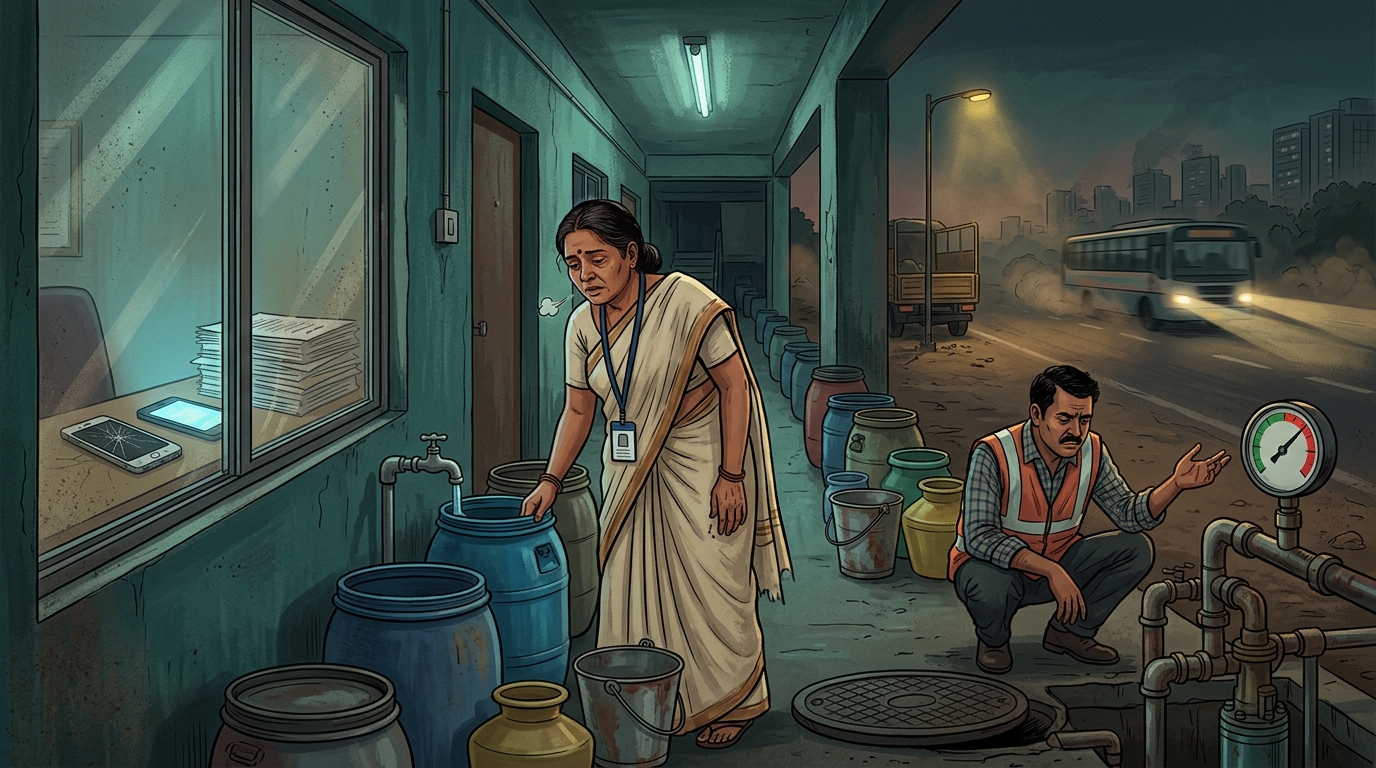
There is also a worker welfare dimension that is easy to overlook. Tens of thousands of Hyderabad's IT workforce commute from peripheral areas — Kompally, Ghatkesar, Patancheru, Shamirpet — where municipal water supply is already inconsistent. Water stress in these zones translates into reduced quality of life, increased household expenditure on tanker water, and over time, pressure on employers to offer housing or commute benefits that offset what public infrastructure should be delivering.
Chhattisgarh's Rainwater Model: A Mirror Hyderabad Should Look Into
Somewhat ironically, the most instructive story this week for Hyderabad's urban planners and civic-minded professionals comes from Chhattisgarh, which has led the nation in rainwater conservation, with five of its districts ranking among the country's top ten. The state's proposed 'Catch the Rain' plan is a model of decentralised, district-level water management.
Hyderabad receives sufficient annual rainfall to be far less water-stressed than it is. The problem is almost entirely one of governance and infrastructure investment — stormwater drains that double as garbage channels, lakes that have been encroached upon or concretised, and a GHMC that has historically prioritised road construction over water harvesting mandates. Chhattisgarh's example is a reminder that water security is a political choice, not just a climatic fate.
For Hyderabad's startup founders and corporate sustainability officers, rainwater harvesting compliance is also increasingly a regulatory and ESG reporting concern. Buildings seeking green certifications and companies filing environmental disclosures are finding that water stewardship is no longer optional optics — it is a measurable metric.
What This Means for You
- Space-tech founders and investors: ISRO's EOS-05 launch restores confidence in earth-observation data continuity. If your product roadmap depends on satellite data feeds or ISRO partnerships, this is a positive systemic signal worth factoring into your Q3 and Q4 planning.
- IT professionals and remote workers in peripheral zones: Water supply inconsistency in outer Hyderabad is likely to worsen before it improves. Document water-related disruptions and raise them with your Resident Welfare Associations and ward-level GHMC representatives — civic accountability begins at that level.
- Startup founders in agri-tech, climate-tech, or urban infrastructure: The convergence of ISRO's earth-observation capacity and regional water stress creates a genuine product opportunity — from precision irrigation analytics to municipal water-loss detection platforms. The market signal is clear.
- Corporate sustainability and facilities teams: Benchmark your organisation's water harvesting and recycling practices against the new national frameworks emerging from states like Chhattisgarh. Being ahead of compliance is cheaper than catching up to it.