Hyderabad's reputation as a global technology hub rests on a compelling narrative: a city that has transformed itself through investment, innovation, and ambition. But this week, a quieter story unfolded on the city's streets that deserves the attention of every professional who considers themselves a stakeholder in Hyderabad's future.
The Protest That Reflects a Deeper Urban Inequality
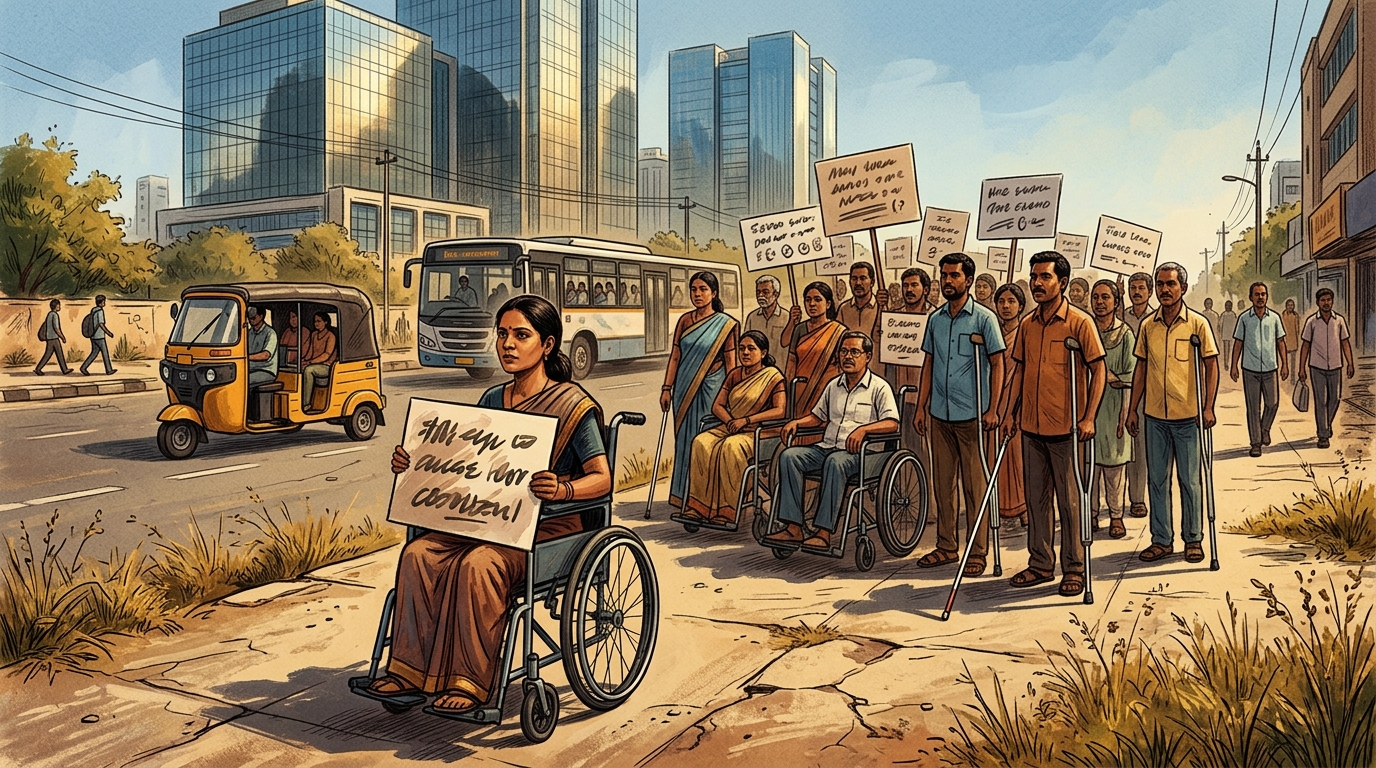
Members of Taratdac — an organisation representing differently-abled persons in Telangana — staged a protest this week demanding that the state government raise the minimum monthly financial assistance for persons with disabilities to Rs. 6,000. The current support levels, by all accounts, fall well short of what is needed to live with dignity in a city where rents in areas like Kukatpally, Miyapur, and even the outer periphery of Gachibowli have climbed steadily over the past five years.
For Hyderabad's IT and business community, this matters more than it might initially appear. The city's tech corridors — Hitec City, Gachibowli, Nanakramguda — have generated enormous wealth and tax revenues. Yet a significant portion of Hyderabad's residents, including differently-abled workers who are employed in support roles across corporate campuses and BPO facilities, remain dependent on state assistance that hasn't kept pace with urban inflation.
The Cost-of-Living Contradiction
Consider the arithmetic. A sum of Rs. 6,000 per month — the amount Taratdac is demanding as a minimum — is still less than the daily billing rate of a mid-level IT contractor in Hyderabad. The contrast is not meant to shame anyone; it is meant to illustrate how dramatically uneven the city's prosperity has become.
For entrepreneurs and startup founders building products in this city, the composition of your local market matters. A population with suppressed purchasing power — particularly among vulnerable groups — constrains the very consumer base that domestic-facing businesses depend on. Inclusive welfare is not charity; it is economic infrastructure.
What the City's Institutions Should Be Doing
GHMC and HMDA have, over the past decade, invested heavily in road infrastructure, IT park connectivity, and commercial real estate facilitation. These are legitimate priorities. But urban planning that doesn't account for the welfare of its most economically fragile residents is planning that will eventually produce social friction — the kind that no amount of flyover construction can resolve.
Progressive cities globally — from Seoul to Amsterdam — have found that robust disability support frameworks not only improve quality of life but reduce long-term public health expenditure and increase workforce participation. Hyderabad's administration would do well to study these models rather than treat disability assistance as a peripheral line item.
What This Means for You
- Corporate employees: Many large IT campuses in Hyderabad employ differently-abled persons in housekeeping, data entry, and accessibility roles. Advocating within your organisations for fair wages and benefits for these colleagues — beyond what the state provides — is both ethically sound and professionally meaningful.
- Startup founders: If you are building HR tech, accessibility tools, or civic-tech platforms, this week's protest is a data point about unmet needs in your own backyard. The market for inclusive design in Hyderabad is real and underleveraged.
- Investors: ESG commitments that stop at carbon offsets and ignore local social equity are increasingly being scrutinised by institutional LPs. Supporting local organisations that advocate for wage floors and disability inclusion is low-cost reputational investment with genuine community impact.
- All professionals: The Taratdac protest is a reminder that Hyderabad's growth story has winners and those who are still waiting to participate. How the city responds to these demands — with genuine policy reform or bureaucratic delay — will say a great deal about what kind of metropolis Hyderabad is choosing to become.
A city that builds world-class data centres while leaving its disabled citizens on Rs. 3,000 a month is not yet the city it claims to be. That gap is worth closing — and it is worth caring about, regardless of which floor of Cyber Towers you work on.