This week's national headlines, stripped of their international noise, reveal a quieter but consequential set of domestic pressures — ones that speak to the health of India's institutions, logistics networks, and the social contract that underpins economic activity. For Hyderabad's professional community, these may seem like distant stories. They are not.
Trucks Stranded, Supply Chains Strained: The Assam-Mizoram Dispute
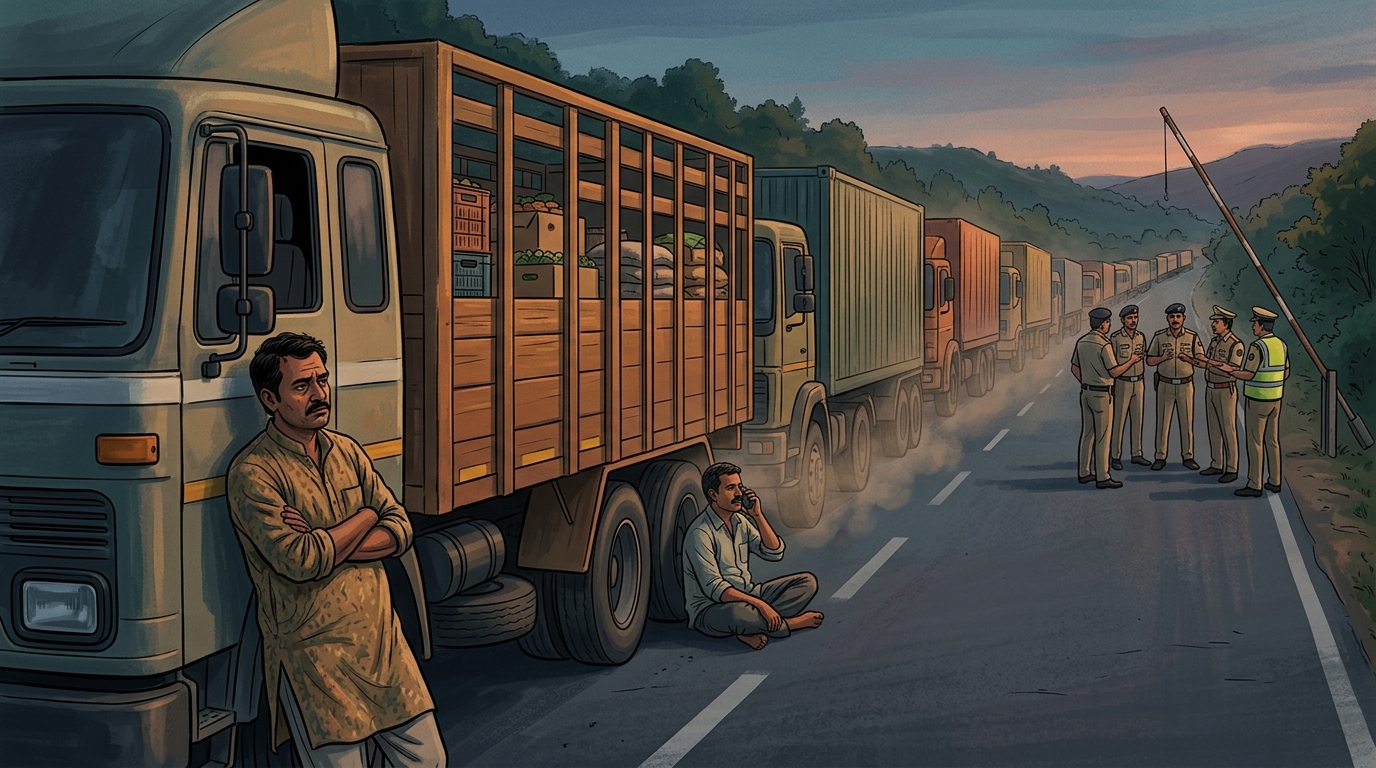
For the third consecutive day, truck drivers have halted traffic on the Assam-Mizoram border, alleging harassment amid the long-simmering inter-state boundary dispute. Vehicles carrying goods remain stranded, disrupting the flow of essential commodities into the Northeast. While this may appear geographically remote from Hyderabad's glass-and-steel tech corridors, the implications are systemic. India's logistics infrastructure remains deeply vulnerable to regional political friction — and any entrepreneur or procurement manager working with pan-India supply chains knows that border disputes are not just a Northeast problem. They are a mirror of how unresolved federal tensions can calcify into recurring economic disruption. The cost of such stoppages is ultimately borne by workers, small traders, and consumers — rarely by those who hold political power on either side of the line.
For Hyderabad-based startups scaling distribution networks or e-commerce operations into Tier 2 and Tier 3 markets across India, this is a reminder that physical logistics remain the Achilles heel of digital ambition. Investing in supply chain resilience and diversified routing is no longer optional strategic thinking — it is baseline risk management.
Punjab's Drug Crackdown and the Cost of Institutional Failure
In Gurdaspur, a police constable and his sister were attacked, allegedly in retaliation for his reporting of drug peddlers in his village. The incident is disturbing not merely as a crime story, but as a signal of institutional fragility. When frontline law enforcement personnel cannot act without facing violent reprisals, it exposes the depth of capture that criminal networks have achieved within local state structures.
This matters to India's business community in ways that go beyond the obvious. Institutional weakness at the local level — whether in Punjab, Uttar Pradesh, or elsewhere — feeds a broader environment of regulatory uncertainty and uneven enforcement. Investors, particularly those in fintech, healthtech, or any sector dependent on regulatory predictability, should note that governance quality across Indian states remains deeply uneven. The same state capacity that protects intellectual property, enforces contracts, and upholds labour rights is the capacity being tested when a constable is beaten for doing his job.
A Tragedy in Faridabad: Education Policy and the Pressure on Young Lives
The death by suicide of a schoolgirl in Faridabad, reportedly following punishment by school authorities over a trivial incident, is a heartbreaking story that demands more than sympathy. It raises urgent questions about disciplinary culture in India's educational institutions — including Navodaya Vidyalayas, which serve lakhs of students from economically weaker sections. These are not peripheral institutions. They are pipelines into India's workforce, including its tech sector.
For professionals in Hyderabad's IT and startup ecosystem — many of whom mentor, hire, or lead teams built on India's vast educational infrastructure — the mental health and dignity of students is a talent pipeline issue as much as it is a human rights one. A school culture that weaponises punishment rather than nurturing resilience produces workers who carry invisible wounds into the workplace. The recent surge in corporate interest in employee mental health cannot be decoupled from the question of what kind of educational environments young Indians are shaped by.
What This Means for You
- Supply chain managers and founders: The Assam-Mizoram disruption is a live case study in why logistics redundancy and inter-state political risk must be factored into operational planning, not treated as edge cases.
- Investors and policy watchers: Punjab's drug-violence episode reflects the state-capacity deficit that affects investor confidence and regulatory reliability across multiple sectors.
- HR leaders and people managers: The Faridabad tragedy is a call to examine what your organisation is doing — concretely — to support the mental health of early-career employees who may have arrived carrying the scars of punitive institutional cultures.
- All professionals: These stories are connected by a thread — the health of India's public institutions. Strong public services, from law enforcement to education, are not socialist luxuries. They are the foundation on which private enterprise operates. Their erosion is everyone's problem.