India's national conversation this week is dominated not by economic policy or market movements, but by something more fundamental: the integrity of its democratic institutions. For Hyderabad's business and IT community — a cohort deeply invested in regulatory predictability, rule of law, and stable governance — the signals emerging from Delhi and beyond deserve careful attention.
The Election Commission Row: Why Institutional Trust Matters to Business
Opposition leader Rahul Gandhi announced plans to file a petition in the Supreme Court challenging Chief Election Commissioner Gyanesh Kumar, alleging conduct unbecoming of the office. While the specifics of the charge remain contested, the broader pattern is harder to dismiss. When confidence in an electoral referee erodes — regardless of which side is making the argument — the downstream consequences for governance quality are real.
For entrepreneurs, investors, and IT professionals whose livelihoods depend on policy continuity, a weakened or politically compromised election commission creates long-term uncertainty. Foreign institutional investors and global technology companies evaluating India as a destination routinely assess democratic health as a proxy for regulatory reliability. A credible, independent election authority is not a partisan talking point — it is a component of the investment ecosystem.
Tribal Home Demolitions: The Human Cost of Policy Gaps
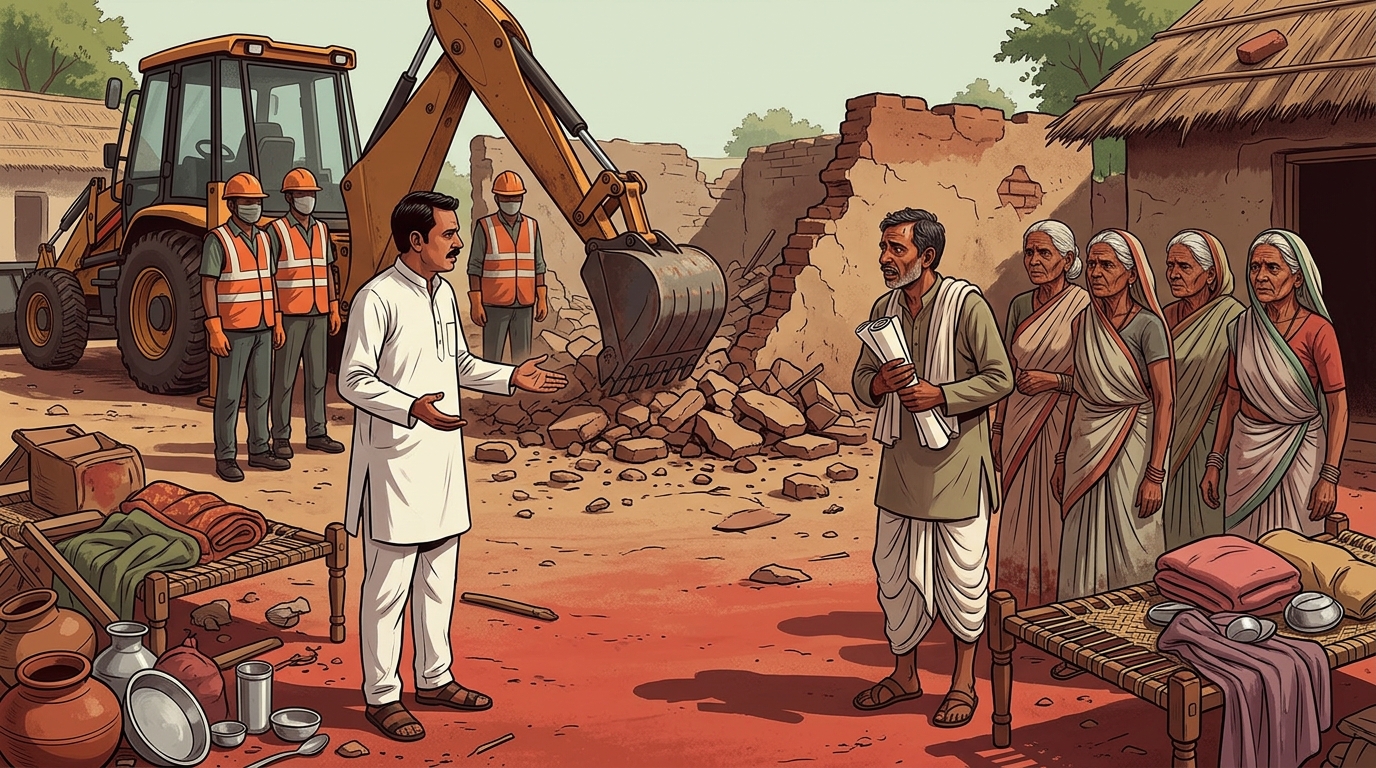
Twelve tribal homes were demolished in a village falling within Union Minister Shivraj Singh Chouhan's own parliamentary constituency in Madhya Pradesh — prompting Chouhan himself to join protests against the action. The episode is striking precisely because it illustrates how poorly coordinated land administration and forest rights implementation remain across India, even in constituencies with direct ministerial representation.
This is relevant to Hyderabad's professional community in a specific way. India's technology and infrastructure sectors are land-hungry — data centres, semiconductor fabrication units, logistics parks, and green energy installations all require large parcels. When land governance is opaque, inconsistently applied, or prone to sudden reversals, it increases project risk and legal exposure for companies operating in these verticals. The tribal land demolition story is a symptom of a deeper problem: India has not yet built a land rights framework that balances development with constitutional protections for marginalised communities. That gap costs everyone — including the business sector — in the long run.
The JNU Harassment Case: Workplace Safety as a Professional Issue
The sacking of Congress MP Angomcha Bimol Akoijam by Jawaharlal Nehru University following a finding of sexual harassment is a reminder that institutional accountability mechanisms — when they function — can and do deliver consequences regardless of political status. For Hyderabad's IT sector, which employs a large and growing proportion of women professionals, workplace safety and grievance redressal frameworks are not abstract concerns.
India's POSH (Prevention of Sexual Harassment) Act has been on the books since 2013, but implementation remains uneven, particularly in smaller startups and mid-sized firms. The JNU case, while rooted in academia, reinforces that Internal Complaints Committees must be genuinely independent and empowered — not performative. Companies that treat compliance as a checkbox rather than a cultural commitment will increasingly find themselves on the wrong side of both the law and the talent market.
The Tirumala Land Dispute: Governance of Public Trusts
A BJP leader and member of the Tirumala Tirupati Devasthanams board pushed back against a land usage order, citing the TTD Act of 1997 and arguing that TTD property cannot be subleased in violation of applicable rules. While this may appear to be a narrow religious trust matter, it touches on a broader question about the governance of large public endowments and quasi-governmental bodies in India. The TTD manages assets worth thousands of crores. How such bodies are administered — and whether their governance is subject to genuine oversight or political patronage — matters to anyone concerned with public accountability.
What This Means for You
- Investors and founders: Institutional erosion — whether in electoral bodies, land administration, or public trusts — increases the risk premium on long-term commitments in India. Push for regulatory clarity and transparent governance in any due diligence process.
- IT professionals and employees: The JNU harassment ruling is a reminder to audit your own organisation's POSH compliance. Advocate for genuinely independent Internal Complaints Committees, not just paper compliance.
- HR and People teams: Workplace safety frameworks directly affect talent retention, especially among women in tech. Build them to function, not just to exist.
- Policy-watchers: The cumulative stress on India's democratic institutions — election commission credibility, land rights enforcement, public trust governance — is not background noise. It is the operating environment for every business decision made in this country.
None of these stories is individually catastrophic. But taken together, they paint a picture of an institutional architecture under strain. For a professional community that has benefited enormously from India's stable-enough governance of the past three decades, this is not a moment for complacency.