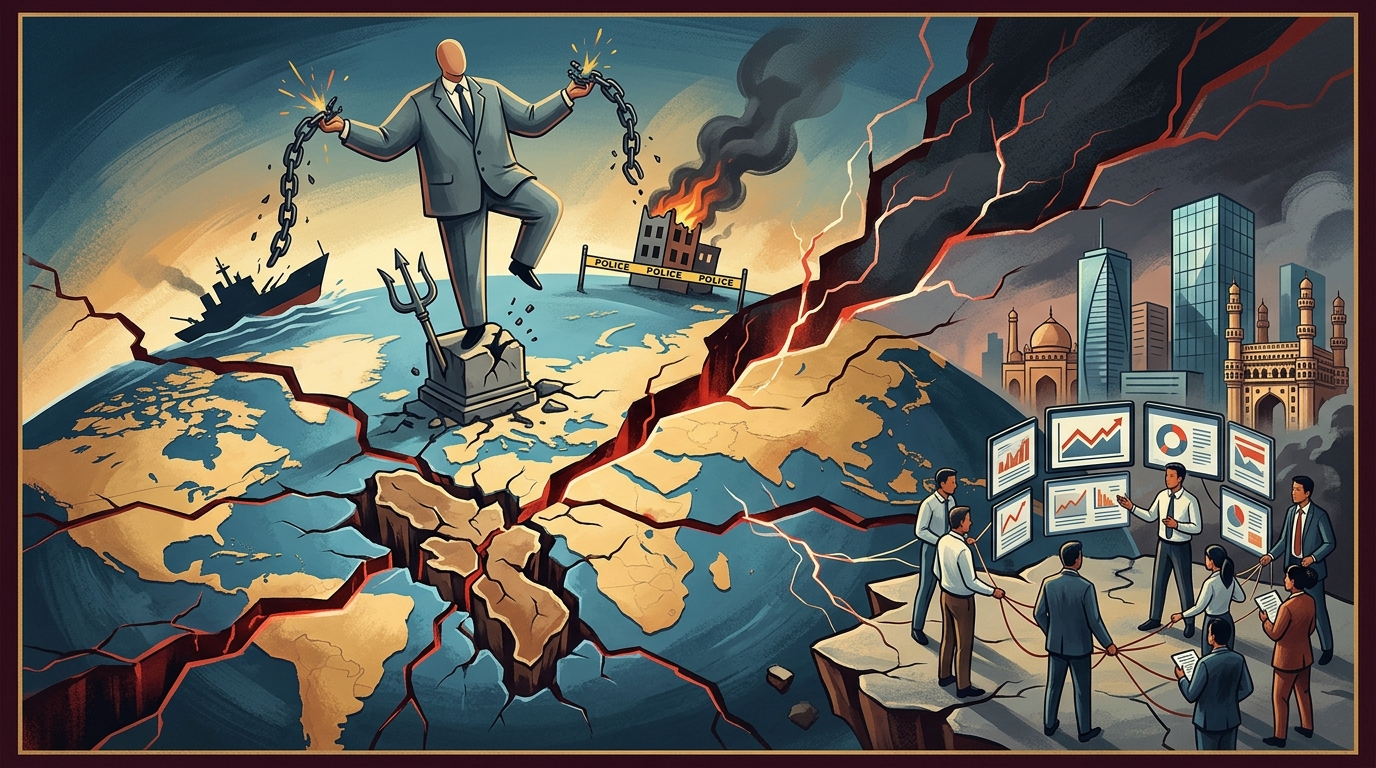
This week's international news cycle carries several developments that, at first glance, may seem distant from the glass towers of HITEC City or the startup corridors of Gachibowli. Look closer, and the threads connecting global geopolitics, security, and diplomacy to the daily realities of India's IT capital become difficult to ignore.
Trump and Burnham: A Diplomatic Signal Worth Watching
In a closely watched meeting in New York, U.S. President Donald Trump said he could 'do business' with Andy Burnham — a statement that, while seemingly cordial, was shadowed by Trump's sharp criticism of the UK's proposed Chagos Islands deal. The arrangement, negotiated under the previous UK government, would hand sovereignty of the Chagos Islands to Mauritius while the UK leases back the strategically critical Diego Garcia military base.
Trump's open hostility to the deal is significant. Diego Garcia hosts one of the most important Western military installations in the Indo-Pacific region — a base that plays a direct role in U.S. and allied power projection across the Indian Ocean, a maritime corridor that handles an enormous share of global trade, including technology hardware, semiconductors, and energy supplies that flow into and out of South Asia.
If American pressure derails or restructures this agreement, it signals a broader pattern: the United States under Trump is actively reshaping multilateral arrangements, often unilaterally. For professionals in Hyderabad whose companies operate across U.S., UK, and European markets, this kind of geopolitical volatility translates into unpredictable regulatory environments, shifting foreign policy alignments, and potential disruptions to supply chains that underpin the global tech economy.
Manchester Terror Plot: A Reminder of Security Risks for Diaspora and Global Teams
British counter-terrorism police announced the disruption of a plot targeting Manchester's Jewish community, with two men arrested. While the investigation is ongoing and details remain limited, the incident is a sobering reminder that security threats in major Western cities have cascading effects beyond their immediate geography.
Hyderabad's IT sector is deeply integrated with the UK and European markets. Thousands of professionals here work for UK-headquartered firms, collaborate with British colleagues, or are themselves part of diaspora networks with family in cities like Manchester, Leicester, and London. When security incidents occur in these cities — particularly those with sectarian or extremist dimensions — they affect employee well-being, business travel decisions, and the broader climate of openness that cross-border professional collaboration depends upon.
There is also a labour market dimension. The UK's ability to attract and retain international tech talent — including a significant number of professionals of Indian origin — is partly contingent on its reputation as a stable, safe, and inclusive society. Incidents like these, when they occur repeatedly, contribute to a chilling effect that ultimately affects hiring pipelines and visa policy debates.
What the Bigger Picture Tells Us
Taken together, this week's international developments point to a world in which the post-Cold War liberal order is under sustained pressure — from within and without. The United States is increasingly transactional in its foreign policy. The United Kingdom is navigating a difficult path between its Atlantic alliance and its post-Brexit global ambitions. And security threats continue to test the social cohesion of open, multicultural societies.
For Hyderabad's business and IT community, this matters in concrete ways:
- Trade and supply chain risk: Instability around strategic military and maritime corridors like Diego Garcia affects the reliability of global logistics networks, including those that deliver hardware and components to data centres and manufacturing facilities.
- Client and project stability: Geopolitical friction between the U.S. and its allies can delay or restructure outsourcing contracts, particularly in defence-adjacent technology sectors where compliance requirements shift rapidly.
- Talent mobility: Security concerns and political volatility in Western cities affect how easily professionals can travel for client engagements, conferences, or short-term assignments.
- Investor sentiment: Global uncertainty tends to compress risk appetite among institutional investors, which can slow down funding rounds for Hyderabad-based startups that depend on foreign venture capital.
What This Means for You
If you are a tech professional, entrepreneur, or investor in Hyderabad, the week's headlines are a useful reminder that global events are not background noise — they are part of the operating environment your business exists within. The Trump administration's assertive renegotiation of Western alliances, the fragility of security in major cities, and the ongoing restructuring of post-pandemic geopolitics all have downstream effects on contracts, capital, and careers.
The most resilient professionals and organisations will be those who track these developments not as distant news, but as variables in their own risk and opportunity calculus. Diversifying client geographies, staying informed about regulatory shifts in key markets, and building adaptable teams are not just good business practice — in the current global climate, they are essential.