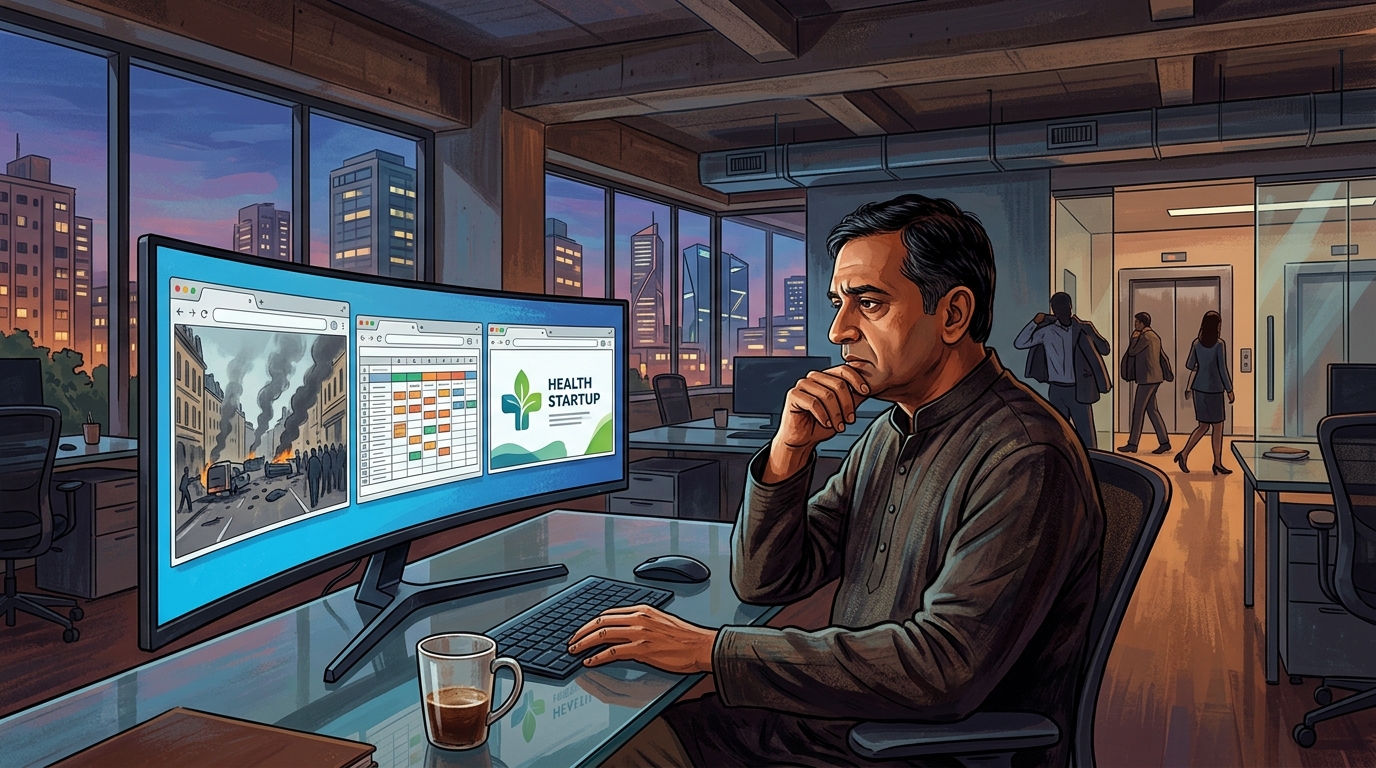
Three stories emerging from the United Kingdom this week — an extraordinary death toll from back-to-back heatwaves, intensifying wildfires, and a remarkably fast-tracked Ebola vaccine now entering human trials — form a coherent and sobering picture of a world navigating compounding crises. For Hyderabad's business and IT professional community, these are not distant headlines. They are early signals of systemic shifts that will reshape everything from global delivery timelines to investment opportunities in life sciences.
Europe's Heatwave Crisis: A Climate Reckoning Nobody Can Ignore
More than 2,700 people are estimated to have died during exceptional heatwaves that gripped England and Wales in May and June, according to BBC News reporting. The majority of those deaths occurred during the June heatwave, which triggered a rare red heat alert — the highest category of warning issued by UK meteorological authorities. This week, temperatures are expected to intensify again as a second heat surge builds across much of Britain, accompanied by active wildfires in multiple regions.
To understand why this matters beyond its immediate human tragedy: the United Kingdom is not a country that historically prepares for extreme heat. Its infrastructure — housing, public transport, hospitals, even its data centres — was largely built for a temperate climate. When systems designed for one climate reality encounter another, the failures are cascading. Power grids are strained. Worker productivity collapses. Logistics slow. And critically for the global IT economy, data centre cooling costs spike and uptime guarantees become harder to honour.
Many of Hyderabad's largest IT employers — TCS, Infosys, Wipro, Cognizant, and a host of GCCs (Global Capability Centres) — deliver services to UK-based clients across banking, insurance, retail, and public sector verticals. When client-side operations are disrupted by climate events of this scale, project timelines, SLA commitments, and revenue recognition cycles are all affected downstream. This is no longer a theoretical risk; it is an operational one.
The wildfires burning across the UK add another dimension. They signal that what was once considered a Mediterranean or Australian problem has now arrived in northern Europe. For professionals working in enterprise risk, business continuity planning, or ESG compliance — a growing function within Hyderabad's GCC ecosystem — this represents a significant recalibration of what 'climate risk' looks like in client geographies.
The Eight-Week Ebola Vaccine: A Signal for Biotech and Deep Tech Investors
In a development that deserves far more attention than it has received, UK regulators have approved human trials for an experimental Ebola vaccine developed in just eight weeks. This is not merely a public health milestone — it is a demonstration of what compressed, well-funded, regulatory-agile vaccine development can look like in the post-COVID era.
The implications for Hyderabad's growing life sciences and biotech ecosystem are direct. The city is home to a significant cluster of pharmaceutical companies, contract research organisations, and increasingly, biotech startups working at the intersection of AI and drug discovery. The UK's willingness to fast-track emergency vaccine trials — using regulatory frameworks sharpened by the COVID-19 experience — signals a global shift toward adaptive, speed-oriented biomedical innovation pipelines.
For startup founders and investors in Hyderabad's life sciences space, this is worth watching closely. Global partnerships, regulatory harmonisation, and technology transfer agreements are likely to follow such breakthroughs. Indian biotech has historically been strong in manufacturing scale; the frontier is now in early-stage discovery and trial design, areas where AI-driven tools developed by local startups could find genuine international relevance.
The Bangkok Bar Fire: A Reminder About Worker Safety in Hospitality Supply Chains
At least 27 people were killed and 22 critically injured when fire engulfed a bar in Bangkok's Chatuchak district. Patrons were seen running through flames to escape. While this is a tragedy centred in Thailand, it resonates with a broader pattern of fire safety failures in rapidly commercialised urban entertainment districts across Asia — failures that are frequently tied to lax enforcement, under-resourced regulatory bodies, and the prioritisation of commercial throughput over worker and patron safety.
For Hyderabad professionals with interests in Southeast Asian markets — whether through investment portfolios, business travel, or supply chain partnerships — this is a reminder that ESG due diligence must extend beyond carbon metrics to basic safety infrastructure in partner geographies.
What This Means for You
- IT & GCC employees: If your team supports UK-based clients, now is a good time to proactively review business continuity protocols. Climate-related disruptions in client geographies are no longer edge cases — build them into your risk frameworks and client communication strategies.
- Startup founders in biotech and AI: The UK's fast-tracked Ebola vaccine trial signals that the global appetite for rapid, AI-assisted drug discovery is real and funded. Explore whether your technology stack has applications in trial design, genomic analysis, or regulatory documentation — there may be partnership opportunities worth pursuing.
- Investors and ESG professionals: Recalibrate your climate risk models for European markets. The assumption that physical climate risk is concentrated in the Global South is being dismantled in real time. Portfolios with UK or European exposure need updated scenario planning.
- Business travellers and operations managers: The Bangkok fire is a reminder to independently verify fire safety standards and evacuation infrastructure when operating in or travelling to rapidly developing commercial districts across Southeast Asia — don't rely solely on official certifications.
The world is not simply becoming more volatile. It is revealing, with increasing clarity, where under-investment in public infrastructure, climate adaptation, and regulatory rigour creates systemic fragility. For professionals in Hyderabad's globally integrated economy, the ability to read these signals early — and act on them — is itself a competitive advantage.