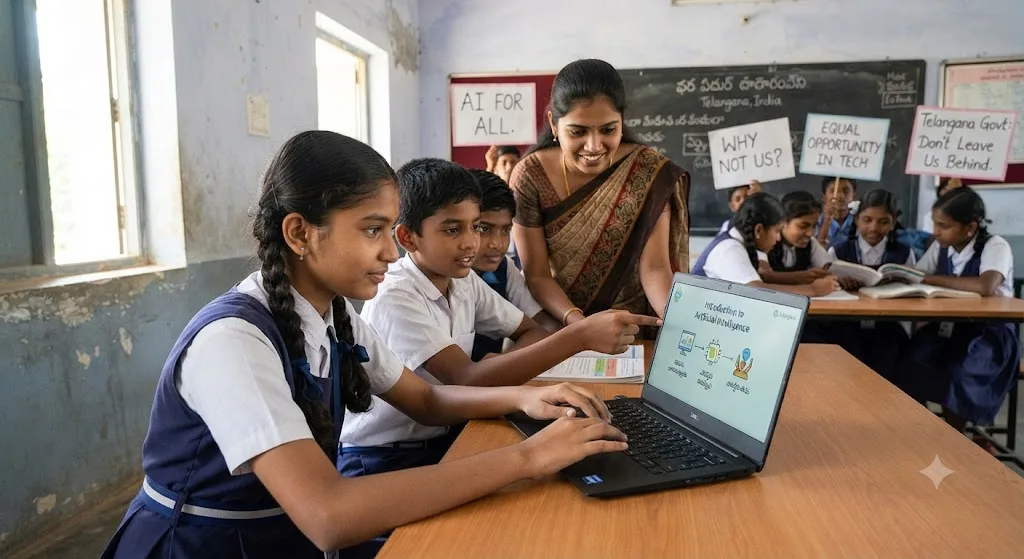
Telangana's decision to roll out artificial intelligence training to approximately 80,000 students enrolled in Telangana Minorities Residential Educational Institutions Society (TMREIS) schools — beginning Independence Day, August 15 — is a commendable first step. It signals that the state government understands what is at stake in the coming decade: young people who graduate without digital fluency, and specifically without exposure to AI fundamentals, risk being left behind in a job market that is already transforming around them.
But a first step should not be the last step. And that is the conversation Telangana needs to have right now — before the programme launches, while the infrastructure, curriculum and intent are still being shaped.
A Welcome Move That Reveals a Larger Gap
The TMREIS initiative targets minority residential school students, a population that has historically faced structural disadvantages in accessing quality education and technology. Reaching them with AI training is meaningful and just. No one is arguing otherwise.
What advocates, educators and technology professionals are pointing out is this: the same logic that makes AI training urgent for minority students makes it urgent for every government school student in Telangana. The digital divide does not run only along communal lines. It runs along economic lines, geographic lines and the simple accident of which school a child's family could afford. A student in a government school in Narsingi or Kokapet — or in a mandal town in Nalgonda — faces the same technological future as a TMREIS student. They deserve the same preparation.
The Case for Mandatory AI Basics in Classes 9 and 10
Education policy experts broadly agree that Classes 9 and 10 represent a critical intervention window. Students at this stage are old enough to grasp foundational concepts — how machine learning works, what data means, how algorithms make decisions — yet young enough that exposure can genuinely shape career trajectories and college choices. Waiting until junior college or undergraduate level means millions of students have already self-selected out of technology pathways.
A mandatory module in AI basics for all government school students in Classes 9 and 10 need not be elaborate. It does not require expensive hardware in every classroom on day one. What it requires is:
- A structured, age-appropriate curriculum covering AI concepts, digital ethics and basic data literacy
- Teacher training programmes that run in parallel, so educators feel equipped rather than overwhelmed
- A phased rollout — beginning with districts like Rangareddy, where Kokapet and Narsingi fall, given the density of IT infrastructure and proximity to training resources
- Partnerships with the technology sector, several of whose major campuses and offices are located within or adjacent to the Neopolis corridor
Why the Neopolis District Has a Stake in This
Kokapet and Narsingi have transformed into one of Hyderabad's most active IT and residential corridors. The district is home to thousands of technology professionals, many of whom work in sectors — software development, data science, cloud infrastructure — that are already being reshaped by AI. Their children, and the children of the support and services workforce that keeps this district running, study in government and semi-government schools across Rangareddy.
For this community, the question of AI literacy in schools is not abstract. It is a question about whether the next generation of local talent will be competitive, or whether Hyderabad's IT corridor will continue to import skilled workers from elsewhere while local youth remain undertrained. Business owners, landlords and residents who have invested in Neopolis's growth have a direct interest in the educational ecosystem of the district improving.
A Direct Request to the Chief Minister
The TMREIS AI training programme demonstrates that the Telangana government has both the intent and the capacity to act. The curriculum is being developed. Partnerships are presumably in place. The political will exists.
We respectfully urge Chief Minister A. Revanth Reddy to consider an expansion of this initiative — not as a separate scheme, but as a natural and logical extension of what is already being built. Direct the School Education Department to design a mandatory AI fundamentals module for Classes 9 and 10 across all government schools in Telangana. Begin with a pilot in districts like Rangareddy where support infrastructure is strongest. Scale from there.
Every child in a government school in this state deserves a shot at the future that technology is building. The TMREIS programme proves it can be done. Now it must be done for all.
What This Means for You
If you are a resident or professional in Kokapet or Narsingi, here is why this matters to you directly. The government schools in and around your neighbourhood educate children of domestic workers, drivers, small shop owners and junior staff — people whose families power the daily life of this district. If those children graduate without AI literacy while the job market demands it, the social and economic consequences will be felt locally. Supporting an expansion of this programme — by writing to your ward representatives, engaging with school management committees, or simply amplifying the conversation — is an investment in the community you live and work in.