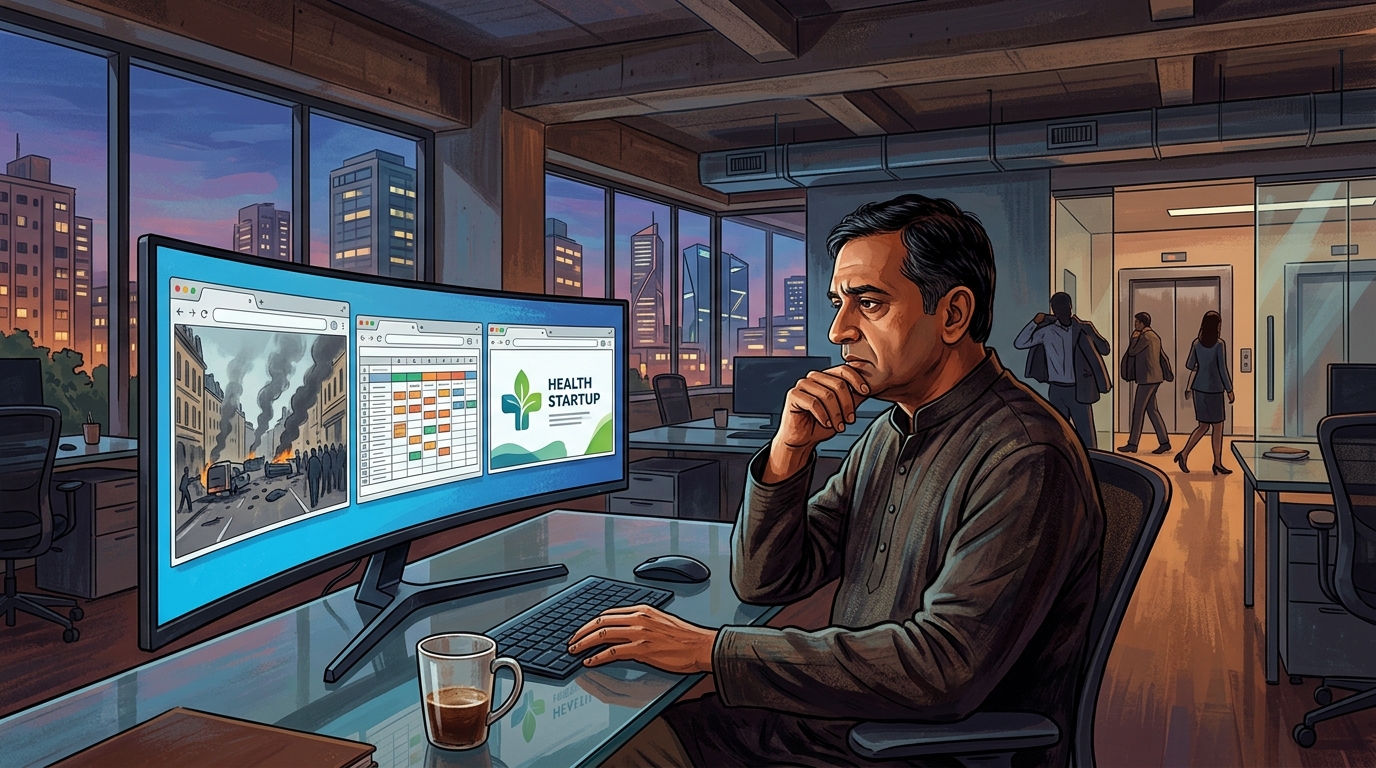
Three developments from across the globe this week deserve close attention from Hyderabad's IT workforce and business community — not because they are distant abstractions, but because they trace the fault lines of the world economy that every professional here is embedded in, whether they recognise it or not.
Ukraine Strikes Russian Oil Infrastructure — Energy Markets Brace
Ukrainian President Volodymyr Zelensky confirmed that Ukrainian forces struck a major oil terminal near St Petersburg, describing it as infrastructure that "generates revenue for Russia's war machine." The strike is strategically significant. Russia's Baltic-region export terminals are critical conduits for oil reaching European and Asian markets. While India has been a major buyer of discounted Russian crude over the past two years — a fact that has kept energy input costs manageable for data centres, logistics firms, and manufacturing units — sustained targeting of export infrastructure introduces fresh volatility into an already strained global energy supply picture.
For Hyderabad's startup founders and IT park operators, energy cost stability is not a peripheral concern. Cooling infrastructure, uninterrupted power supply units, and cloud data centre operations are all sensitive to electricity tariff movements, which in turn respond to global crude benchmarks. A prolonged disruption in Russian oil export capacity could tighten supply and push Brent crude upward, reversing some of the cost relief businesses have enjoyed. Investors evaluating capital expenditure in hardware-heavy verticals — semiconductors, IoT, edge computing — would do well to model scenarios where energy costs climb 10–15 percent over the next two quarters.
Record European Heatwave Extends Into a Week-Long Health Emergency
A new heatwave is forecast to peak at 34°C across parts of the United Kingdom, with health authorities issuing a week-long alert — an almost unthinkable figure for a country that spent most of its history without air conditioning in public buildings. The frequency and duration of such events is no longer surprising to climate scientists, but the policy and economic implications continue to unfold in real time.
For Hyderabad professionals, this matters on two interconnected levels. First, global climate commitments — already under pressure from geopolitical fractures — will face renewed scrutiny as wealthy nations deal with domestic climate emergencies. This typically accelerates ESG reporting requirements and carbon accounting mandates for companies doing business with European clients. IT services firms and GCCs (Global Capability Centres) with European delivery obligations should anticipate tighter sustainability disclosure demands in client contracts over the next 12–18 months.
Second, and perhaps more immediately, the heatwave is a reminder that Hyderabad itself is not insulated from climate risk. The city already experiences extreme heat events. The European experience — where productivity losses, health system strain, and infrastructure failure compound rapidly — should inform how local employers think about worker welfare policies: flexible hours, adequate cooling in offices and on campuses, and health support structures. A worker-friendly lens here is not idealism; it is operational resilience.
NHS Deploys AI to Triage Patients — A Model Worth Watching
The United Kingdom's National Health Service announced that its widely used NHS app will integrate artificial intelligence to help determine which healthcare service is most appropriate for a given patient. The rollout is targeted for all users in England by April 2028. This is one of the most significant real-world deployments of AI in a public health system at scale — and it carries lessons that extend well beyond Britain's borders.
India's own health-tech ecosystem, including several firms headquartered in or operating out of Hyderabad, has been building AI-assisted diagnostic and triage tools for years, often with limited formal integration into public health infrastructure. The NHS deployment legitimises the model at a national scale and provides a working reference architecture that Indian health-tech entrepreneurs and policymakers can study. It also signals to global investors that AI in healthcare is moving from pilot phase to mainstream deployment — which could accelerate funding flows into this vertical.
However, it is worth noting the critical difference in context. The NHS model is built on a foundation of universal public healthcare, where the AI serves a public good rather than a profit motive. Health-tech founders in Hyderabad building for private or semi-private markets would do well to reflect on how triage AI can be designed to expand access rather than merely optimise billing — especially as regulatory frameworks in India begin to mature around digital health standards.
What This Means for You
- Energy-exposed businesses: Model energy cost volatility into Q3 and Q4 projections. The Ukraine–Russia conflict's impact on global oil supply is not over, and complacency about stable input costs could prove costly.
- IT services and GCC professionals: If your firm has European clients, expect sustainability and ESG disclosure clauses to tighten. Begin internal audits of your carbon reporting readiness now, not when a contract renewal forces it.
- Health-tech founders and investors: The NHS AI triage announcement is a green light for the sector. Study the implementation model, but build for equity — tools that serve underserved populations will attract both mission-driven capital and regulatory goodwill.
- HR and operations leaders: As heatwaves become more frequent globally and locally, worker welfare policies around heat, flexible hours, and health support are no longer optional soft benefits — they are risk management.